
Your dog barks when you step into the next room. He barks when you pick up your keys. He barks at the mail carrier, at the doorbell on a television show, at a squirrel crossing the yard. If you live with a bored dog, you know the sound by heart. You also know that yelling does nothing, that ignoring it does nothing, and that another walk only buys about eleven quiet minutes.
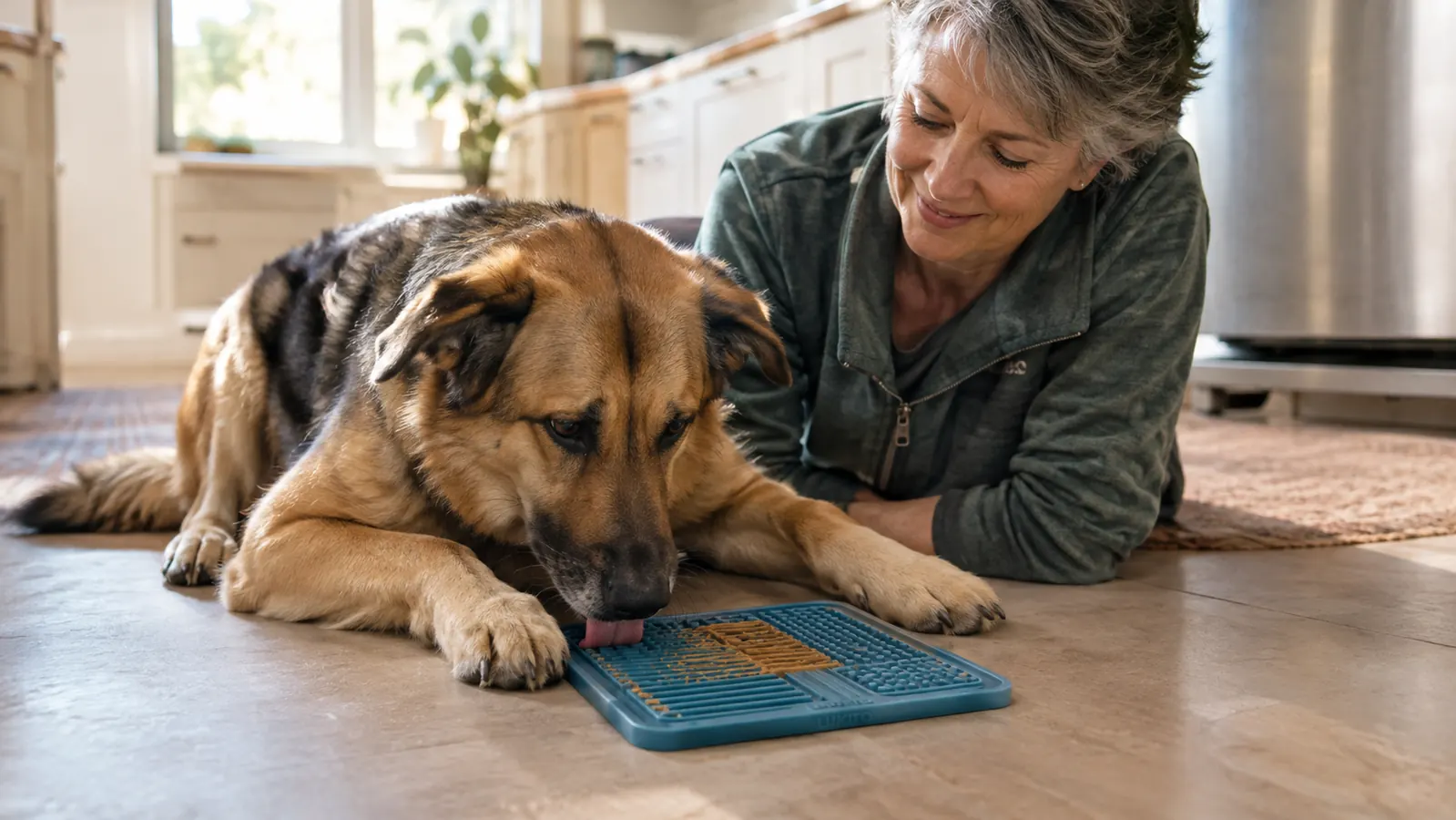
Two and a half years ago I adopted Ridley, a shepherd mix from the local shelter. He was about a year and a half old, 55 pounds, and full of energy he had no idea what to do with. He barked when I left the room, barked when I came back, and barked at the neighbor's cat along the fence line. I tried a puzzle toy he finished in four minutes, longer walks that just made him fitter, and a radio station that mostly confused him. The turning point came when I stopped trying to tire out his legs and started trying to tire out his brain. That is where the LUKITO lick mat came in. It is a flat silicone pad with a textured surface. You spread a filling across it, freeze it, and let your dog work at it with his tongue. Twenty minutes of licking later, the dog who was barking at the window is asleep on his bed. I know because I lived it.
Stop the Boredom Barking Before It Starts
The LUKITO Lick Mat 2 Pack gives your dog a calm, focused job for twenty minutes at a time, and the suction cups hold it in place on tile or inside a crate. It is the tool I reach for before every work call and every trip to the store.
Amazon Check Today's Price on Amazon →Why a Lick Mat Works When a Walk Does Not
Boredom barking is self-reinforcing. The dog barks, nothing changes, so he barks a little more. Licking works on a different channel. The slow, repetitive motion of the tongue releases calming endorphins in a dog's brain, the same reason a puppy settles while nursing. It lowers his heart rate and pulls his attention onto one physical task. A dog cannot bark and lick at the same time, and after twenty minutes of licking, the urge to bark has usually passed.
I want to be honest about what a lick mat is not. It is not a treatment for separation anxiety, and it will not replace training. It is a management tool that buys you a calm window, and a daily one. Over time it also builds a positive association with the situations that used to trigger barking, and that association is what actually changes the behavior. Ridley still gets excited when I pick up my keys, but now he runs to his mat instead of running to the door.
The other thing I learned is that timing beats duration. A mat given ten minutes before the trigger does more than a mat given after the barking has started, because the dog learns to connect the calm activity with the thing that used to worry him. Ridley still knows when I am about to leave. He just has a different response to it now. That response was built one frozen mat at a time.
Step 1: Choose the Right Surface and Spot
Start by deciding where the mat will live, because a mat that is easy to reach is a mat you will actually use. I keep two spots for Ridley. The first is the kitchen floor near his bed, out of the main walkway, for the times I need him settled while I cook or take a call. The second is inside his crate, for the days I have to leave the house. Both spots are quiet, and both are always the same, which is part of the training.
The LUKITO mat has suction cups on the back, and I will admit I was skeptical. A 55-pound dog can fling a bowl across a room when he is excited. The suction cups hold on smooth tile and on the plastic tray of his crate, and they release with a little tab so you do not have to pry them off the floor. Set the mat down, press firmly for a few seconds, and test it with your own hand before you trust it with your dog.
This is also where the two-pack earns its keep. I keep one mat in the kitchen and one in the crate, so I am never washing a mat at the exact moment I need it. They are dishwasher safe on the top rack, though I usually just rinse them under warm water for ten seconds and set them on the drying rack. A spare mat also means I can keep one loaded in the freezer while the other is in use, which is the whole reason the routine stuck.
Step 2: Pick a Filling Your Dog Actually Wants
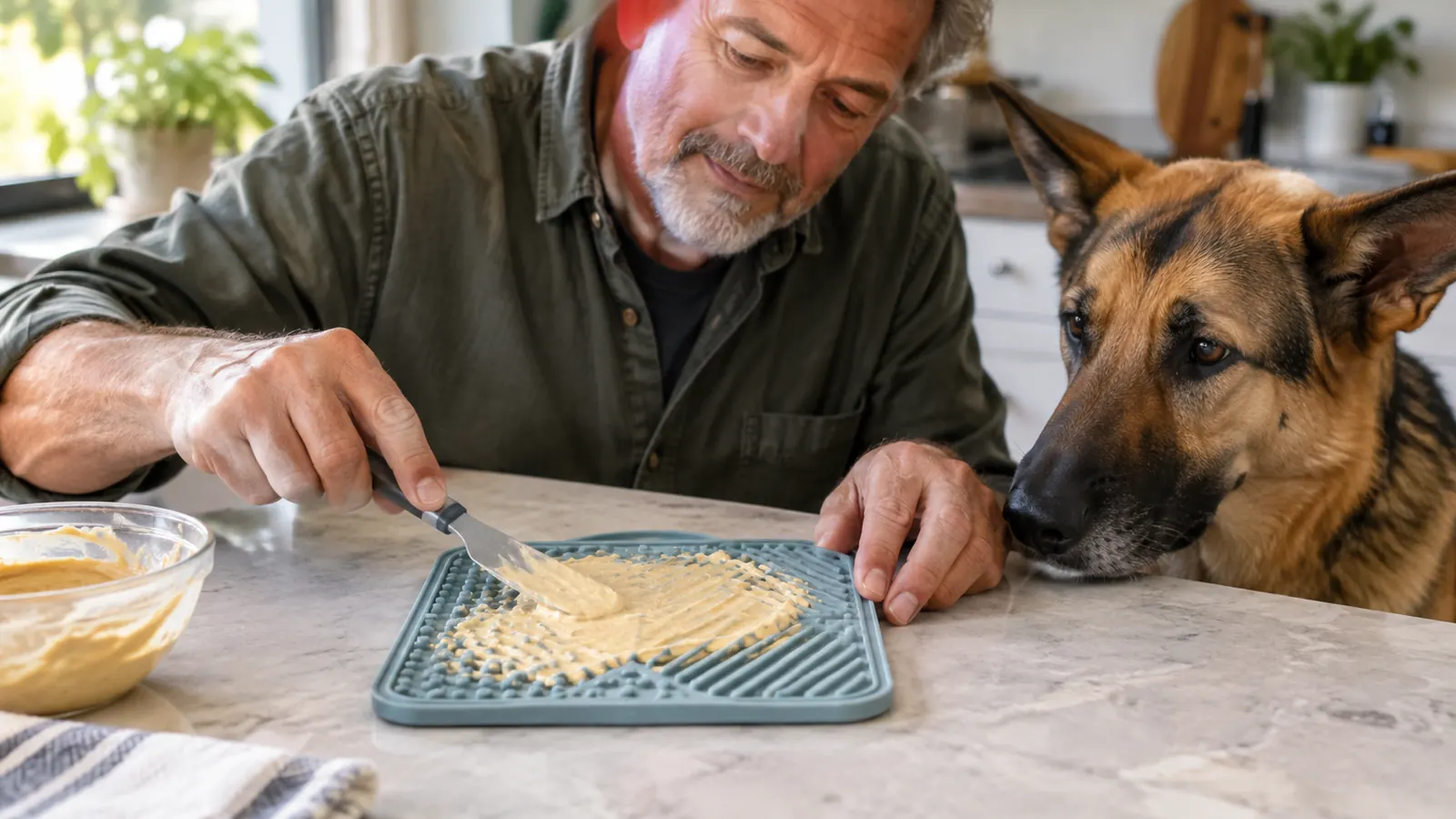
The filling matters more than the mat. If your dog does not care about what is spread on it, the mat is just a piece of silicone. Start with something your dog already loves. Plain unsweetened yogurt, canned pumpkin, mashed banana, or peanut butter without xylitol are all good places to begin. Spread it thin enough that your dog has to work for it, but not so thin that he licks it clean in ninety seconds. A dog who loves the filling will work the whole mat, including the corners, which is where the suction cups earn their keep.
I keep three fillings in rotation for Ridley because novelty keeps the activity interesting. Sunday gets plain yogurt with a spoonful of pumpkin stirred in. Wednesday gets mashed banana with a few pieces of his kibble pressed into it. Friday gets a thin layer of peanut butter. The rotation means he never knows exactly what he is getting, so his attention stays on the mat longer.
One caution from my own early mistake. Read every peanut butter label. Xylitol, a sweetener used in some sugar-free peanut butter, is toxic to dogs. When you are not sure about a filling, stick with plain yogurt or canned pumpkin. Both are safe, cheap, and easy to keep on hand. I keep a can of pumpkin in the pantry at all times, and it doubles as a settle-down snack on rough days.
Step 3: Freeze It and Build Duration Slowly
Here is the step most people skip, and it is the one that turns a five-minute snack into a twenty-minute calm session. Spread the filling, then put the whole mat in the freezer for at least two hours, or overnight. Frozen filling is harder to work off, so your dog has to lick slower and longer. Slower licking is the entire point.
The first time I gave Ridley a frozen mat, he finished it in about four minutes because I had spread the filling too thin and he was frantic. I learned to layer it. A thin base layer, freeze for an hour, then a second thin layer on top, freeze again. The two layers double the work, and Ridley's session stretched to closer to twenty minutes. I now keep two mats loaded in the freezer at all times, which sounds excessive until you need one at seven in the morning on a Tuesday.
Build the habit gradually. Start with ten minutes while you are in the room, then work up to a full session once he is calm. The goal is a dog who sees the mat come out of the freezer, walks to his spot, and settles on his own. That is exactly what Ridley does now, and it did not take as long as I expected.
Step 4: Pair the Mat with the Trigger, Not After It
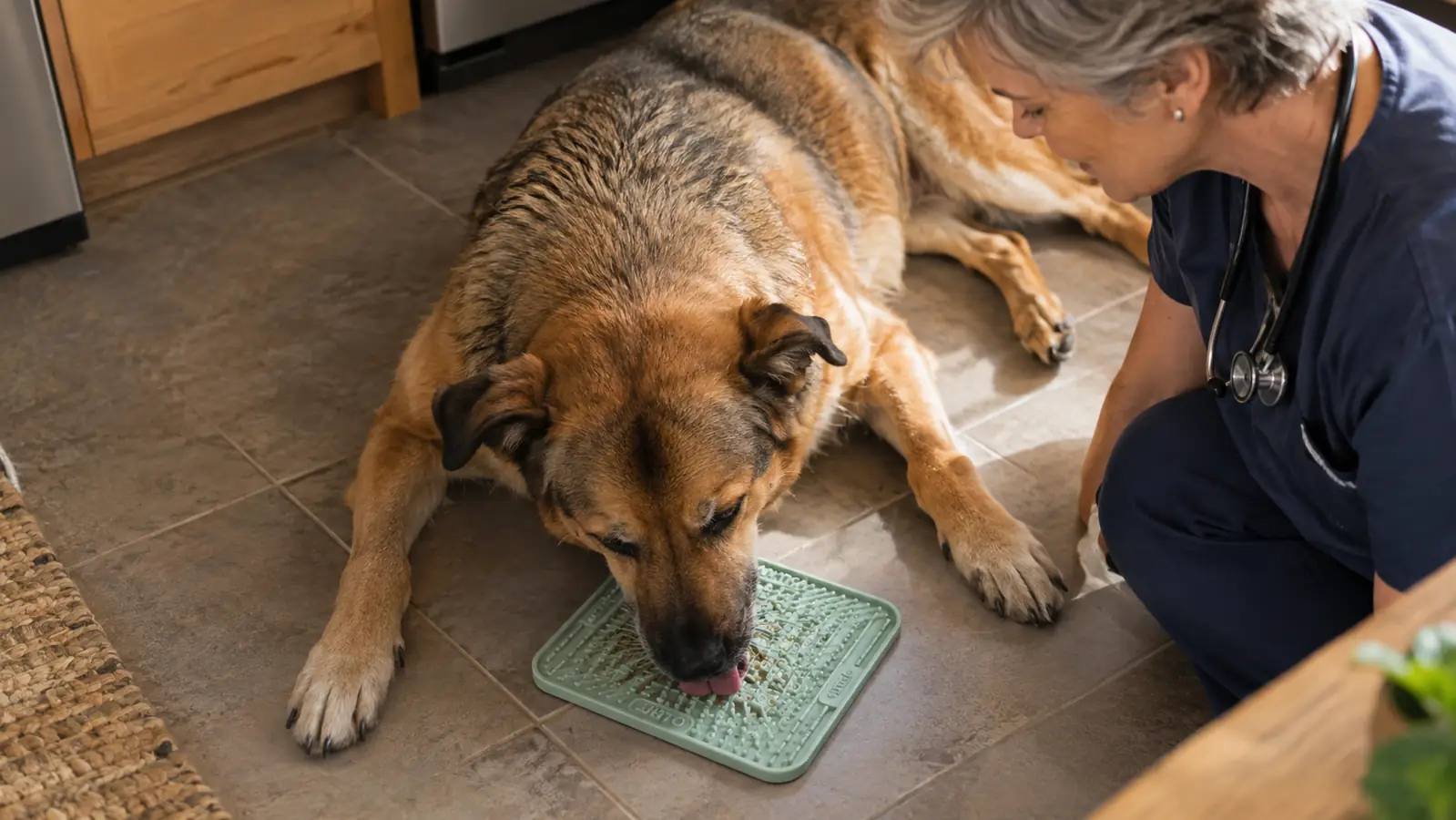
This is the training part, and it is the difference between a dog who is distracted and a dog who is actually calmer. The mat works best when you bring it out before the trigger, not after the barking has started. If Ridley barks when I pick up my keys, I give him the mat and then pick up the keys. I repeat that until the keys mean mat, not panic. The same goes for the front door, the garage door, and the sound of my coat coming off the hook.
The sequence matters more than the timing of each step. Keys on the counter, mat down, keys picked up, keys put down, mat removed. Then keys picked up, walk to the door, mat stays. Then the full exit. Each repetition teaches him that the thing he used to dread now comes with something he loves. The barking drops because the emotion behind it drops.
Use the same approach for the doorbell, the mail carrier, or whatever sets your dog off. I recorded the doorbell on my phone and played it at low volume while Ridley worked on the mat, then raised the volume a little every couple of days. Give each level a few days before you turn it up. If your dog stops licking to stare at the door, you have moved too fast. It is the same principle trainers use for sound sensitivity, and you can do it in your kitchen with a phone and a frozen mat.
Step 5: Keep Sessions Short and End While It Is Still Fun
Short daily sessions beat long weekly ones. Ten minutes of licking, five days a week, did more for Ridley than a thirty-minute session on Saturdays ever did. Dogs learn in small chunks, and a brain that gets a little work every day is a quieter brain than one that gets flooded once a week. I also found that the daily routine helped me as much as it helped him, because I stopped guessing and started following the same pattern.
End every session before your dog loses interest. If Ridley walks away from the mat with a little filling left, I count that as a win, not a failure. It means he is satisfied instead of frantic. I take the mat away, rinse it, and put it back in the freezer. The next session starts fresh, and he is always ready for it.
Keep a rough mental log of progress. I noticed Ridley's alone-time barking dropped noticeably after about three weeks of daily mats. Not gone, but quieter and shorter. That is a realistic timeline, and it is worth repeating. Anyone who promises a silent dog in three days is selling something, and it is not a lick mat. Give yourself three weeks, keep the sessions short, and let the routine do the work.
What Else Helps
The lick mat is the tool I reach for most, but it works best alongside the basics. Ridley gets two neighborhood walks a day, one in the morning and one in the evening, plus a few short training sessions in the kitchen. A dog who has been walked and fed and given a little mental work is a dog who settles faster. I also keep a chew in his crate, because chewing serves a similar calming function to licking.
If your dog's barking is severe, or if it only happens when you leave and comes with drooling, pacing, or destruction, that is beyond boredom. That sounds like separation anxiety, and it deserves a conversation with your vet and a certified trainer. A lick mat is a wonderful support tool, but it is not a treatment plan.
The last thing I will say is to be consistent. The mat works because it is predictable. Same spots, same filling routine, same time of day as often as you can manage. Ridley knows that when the freezer opens in the morning, his mat is coming. That predictability is what made the barking drop, more than any single session.
The barking dropped because the emotion behind it dropped. You are not just distracting the dog. You are changing how he feels about being alone.
Give Your Dog a Calmer Job Than Barking
The LUKITO Lick Mat 2 Pack is the exact mat I keep in the kitchen and the crate, and the two-pack means one is always ready in the freezer. It has been the most useful boredom tool in my training drawer.
Amazon Check Today's Price on Amazon →