
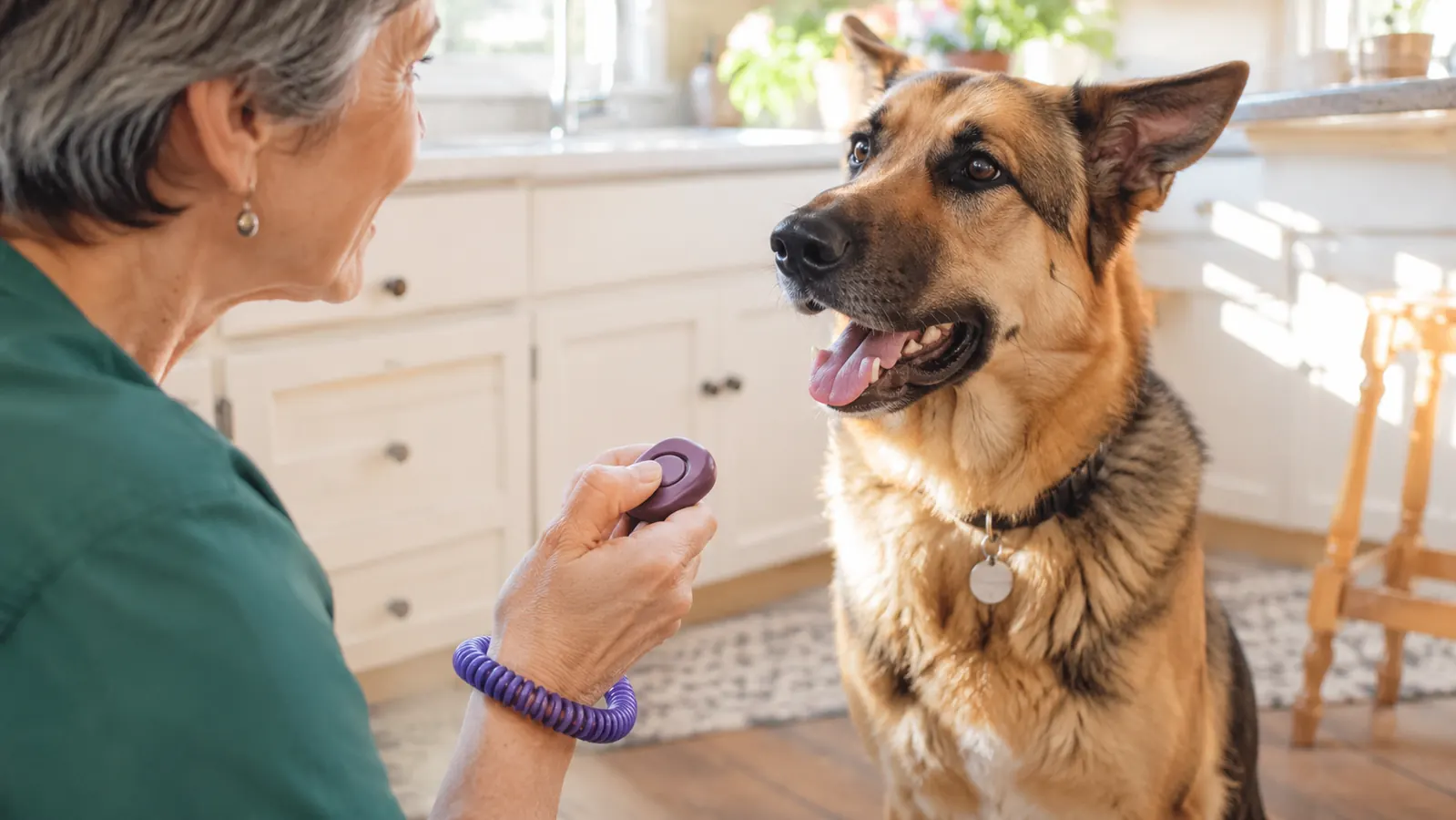
If you have spent any time looking at dog training videos, you have seen the same argument play out in the comments. Clicker people say a plastic box is the only way to mark a behavior cleanly. Verbal marker people say a word is free, always with you, and works just as well. I spent two years training Ridley, a shepherd mix I adopted at about 18 months, and I used both. The honest answer is that they train at the same speed once you understand what each one is actually for. The clicker from HoAoOo that I keep on my wrist is a tool I reach for every day, but not because it is magic. It is because it solves a specific problem that a word cannot solve as cleanly.
Here is the short version. A clicker is a marker, not a reward. It tells the dog the exact instant they did the right thing. A verbal marker like yes does the same job, but your voice carries less information than a click. The click is always the same sound, every single time, in every mood, at every distance. Your voice changes when you are tired, excited, or frustrated. That consistency is the whole argument for the clicker, and it is a real one. But consistency only matters if you can click at the right moment, and that takes practice. For a lot of owners, a word they can say without fumbling is more consistent in practice than a clicker they click a half second late.
I have used both with Ridley, my shepherd mix from the Dane County shelter, and I still use both. What I want to give you here is a plain look at where each one is better, so you can decide based on your own dog and your own habits, not on what a training video says you should do.
| HoAoOo Clicker | Verbal Marker (Yes) | |
|---|---|---|
| Sound consistency | Identical click every time, at any distance | Voice changes with mood, energy, and distance |
| Speed of marking | Instant, one thumb press, no mouth movement | Fast once practiced, but slightly slower to produce |
| Always available | Must be on your wrist or in your pocket | Always with you, hands free, nothing to carry |
| Learning curve | Needs a week of charging the clicker before use | No charging needed, works from day one |
| Best for | Precise behaviors, distance work, shaping new skills | Everyday manners, casual sessions, quick reminders |
Where the Clicker Wins
The clicker wins on precision, and precision is what makes a behavior stick. When I taught Ridley to keep all four feet on the floor when visitors came in, the difference was the exact moment. A click at the instant his front paws touched down told him that was the behavior. With a word, I was usually a beat behind, and that beat was enough for him to start offering a sit instead because he thought that was what I wanted. The click removed the guesswork. Within a week, he was offering a down instead of a jump because the click had taught him which instant paid.
Here is a real example. I was teaching Ridley to lie down on his mat with his hips rolled to one side, which is a more relaxed position than a sphinx down. That hip roll lasts about half a second. With my voice, by the time I said yes he had often shifted again, and I was marking the wrong thing. With the HoAoOo clicker, my thumb was faster than my mouth, and he figured out the hip roll in two short sessions.
The HoAoOo clicker also wins at distance and in noise. In the backyard, with Ridley thirty feet away and the neighbor's mower running, my voice did not carry the way the click did. The click is a sharp, consistent sound that cuts through. I also found it useful for shaping, where you reward tiny steps toward a final behavior. Shaping needs a marker that is identical every single time, because the dog is watching for the smallest difference in your response. The clicker gave me that. The wrist strap and keyring on the HoAoOo model meant I never had to dig for it, which sounds small until you are holding a leash in one hand and a treat pouch in the other.
It also wins on neutrality. When I am frustrated, my yes comes out flat. When I am excited, it comes out as a squeal. Ridley reads all of that. The click sounds the same whether I have had a great day or a terrible one, and that steadiness makes it a very clean signal for a dog who is sensitive to my mood.
The clicker that lives on my wrist
After two years of daily use, the HoAoOo clicker is the one I reach for when precision matters. It is loud enough for the backyard, light enough to forget you are wearing it, and the strap keeps it from disappearing into a pocket.
Amazon Check Today's Price on Amazon →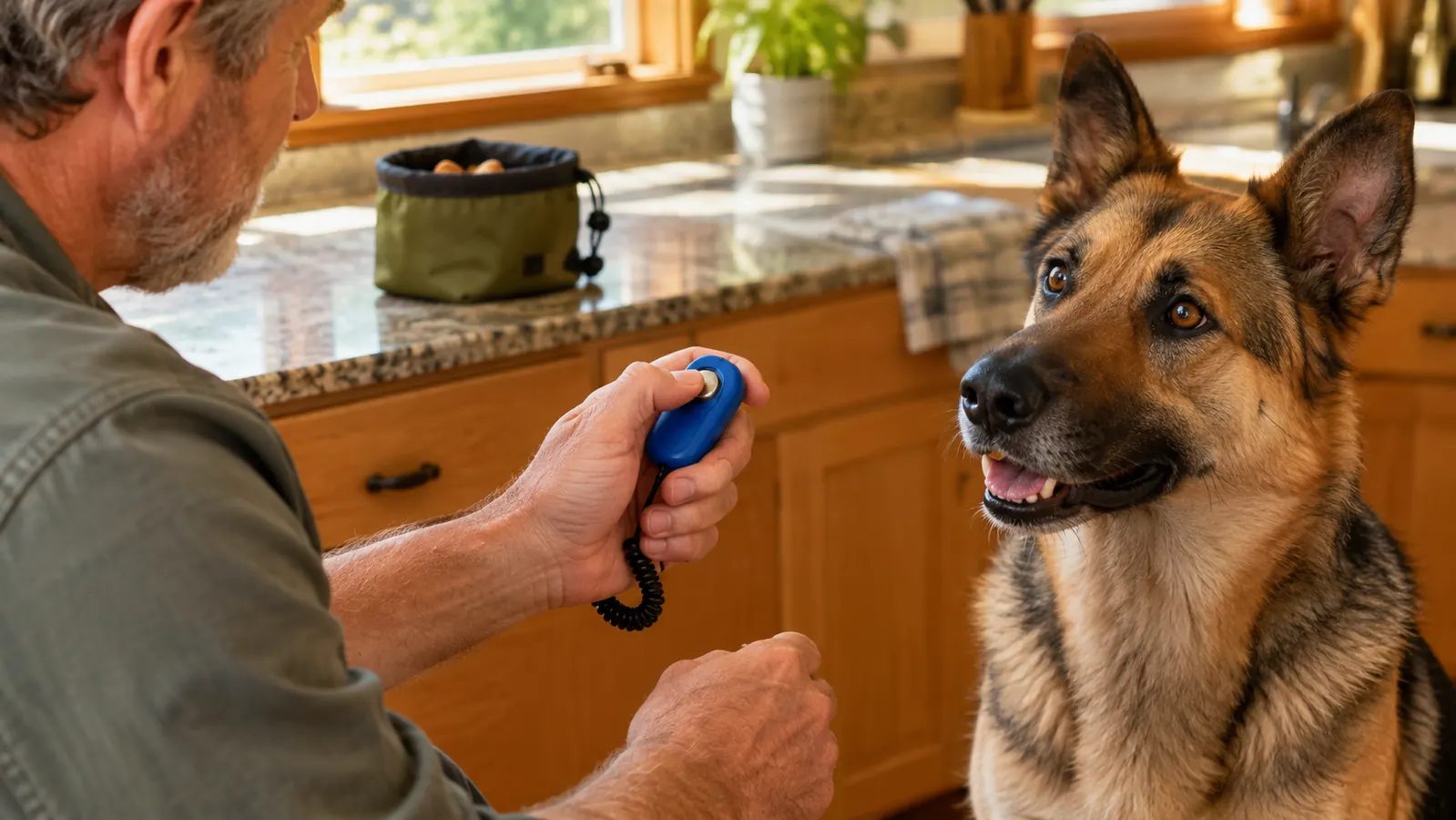
Where the Verbal Marker Wins
The verbal marker wins on convenience, and convenience is what keeps you training. The honest truth is that most of my sessions with Ridley were not formal training sessions. They were moments in the kitchen, on a walk, or in the driveway. In those moments, the word yes was faster than reaching for a clicker, and it worked. When he offered a sit at the front door instead of barreling out, I said yes and dropped a treat. When he looked at a passing dog and then looked back at me, I said yes. Those small repetitions added up to a dog I can take anywhere, and none of them needed a click.
It also costs nothing and can never be lost, forgotten in a coat pocket, or dropped in the snow. When I travel with Ridley, my marker word comes along without me having to remember to pack it, and his training does not skip a beat just because we are away from home.
And because my voice is always there, the verbal marker has quietly become the way I reward calm behavior around the house. That kind of everyday reinforcement adds up over weeks in a way a few formal sessions never could.
There are a lot of moments in a day when I do not have the clicker on me. Ridley settles on his bed while I am cooking, he ignores a delivery truck, he walks past the neighbor's cat without lunging. I want to mark all of those, and my voice is always with me. A verbal marker means no good moment goes unmarked just because the clicker is on the counter.
The verbal marker also wins for people who are new to training or who train in public. There is no charging period, no fumbling, no explaining to a neighbor why you are clicking at your dog. You just say the word. I have also seen the clicker fail in the hands of someone who has not practiced. A late click is worse than a word, because it marks the wrong instant. If you are not going to practice your timing, the word is the more reliable tool. That is not a knock on the clicker. It is a knock on expecting a tool to do the work that practice is supposed to do.
And there is one situation where a verbal marker is simply the better choice: when your hands are full. Walking with a leash in one hand and a treat pouch on the hip, adding a clicker can feel like juggling. Many trainers teach a verbal marker first for exactly this reason, then add a clicker for precise work.

How I Use Both Without Confusing Ridley
The worry I hear most is that using two markers will confuse a dog. In my experience it does not, as long as each marker always means the same thing: a reward is coming. Ridley learned the clicker first, then I charged my yes the same way, by saying it and immediately giving a treat, twenty times a session for a couple of days. After that both sounds meant the same thing to him.
In practice, the clicker comes out for planned sessions. Ten minutes in the kitchen working on a new trick, or a session in the backyard on recall. The verbal yes covers everything else, all the little moments of good behavior that happen during a normal day. I never click without treating, and I never say the marker word casually, because a marker that sometimes means nothing quickly stops meaning anything.
One more habit that helped: I keep the clicker clipped to my treat pouch. When the pouch goes on, the clicker comes with it, and a training session starts without me hunting for it.
A late click is worse than a word, because it marks the wrong instant. The tool only works as well as the timing behind it.
Who Should Buy Which
Buy the clicker if you are training precise behaviors, working at a distance, or shaping something new. Buy it if you are willing to spend a week charging the clicker before you use it, which just means clicking and treating for no reason until the sound means something. Buy it if you want a marker that sounds identical at 7 AM and 9 PM, on a good day and a bad one. The HoAoOo clicker is a good place to start because it is simple, loud, and comes with a strap that keeps it attached to you.
A clicker is also a good choice for anyone training a dog with a short attention span. The click is fast and clean, which keeps sessions moving. With Ridley, a clicker session gets maybe twice as many repetitions into five minutes as a session where I am marking with my voice, simply because there is less of me talking.
It is also worth buying if you have tried a verbal marker and felt like your timing or your tone was getting in the way. A clicker is inexpensive, and a week of trying it will tell you whether it suits you and your dog.
Skip the clicker and use a verbal marker if you only train in short casual moments, if you do not want to carry anything, or if you know you will not practice your timing. A word is a perfectly good marker for everyday manners. The dogs do not care which one you use. They care that the marker is consistent and that it always means a treat is coming. If a word is the thing you will actually use every day, then the word is the better tool for you.
Skip it too if your dog is very sound sensitive and the click causes real worry even after you have muffled it in a pocket. A soft, consistent marker word will do the job, and the relationship matters more than the tool.
Whichever you choose, the rules are the same. Mark the exact moment, follow every marker with a reward, and keep sessions short and upbeat. Get those three right and either tool will serve you and your dog well for years.
Start with the tool you will actually use
For me, that meant keeping the HoAoOo clicker on my wrist for formal sessions and using my voice for everything else. Both worked. The clicker just made the hard parts easier.
Amazon Check Today's Price on Amazon →