
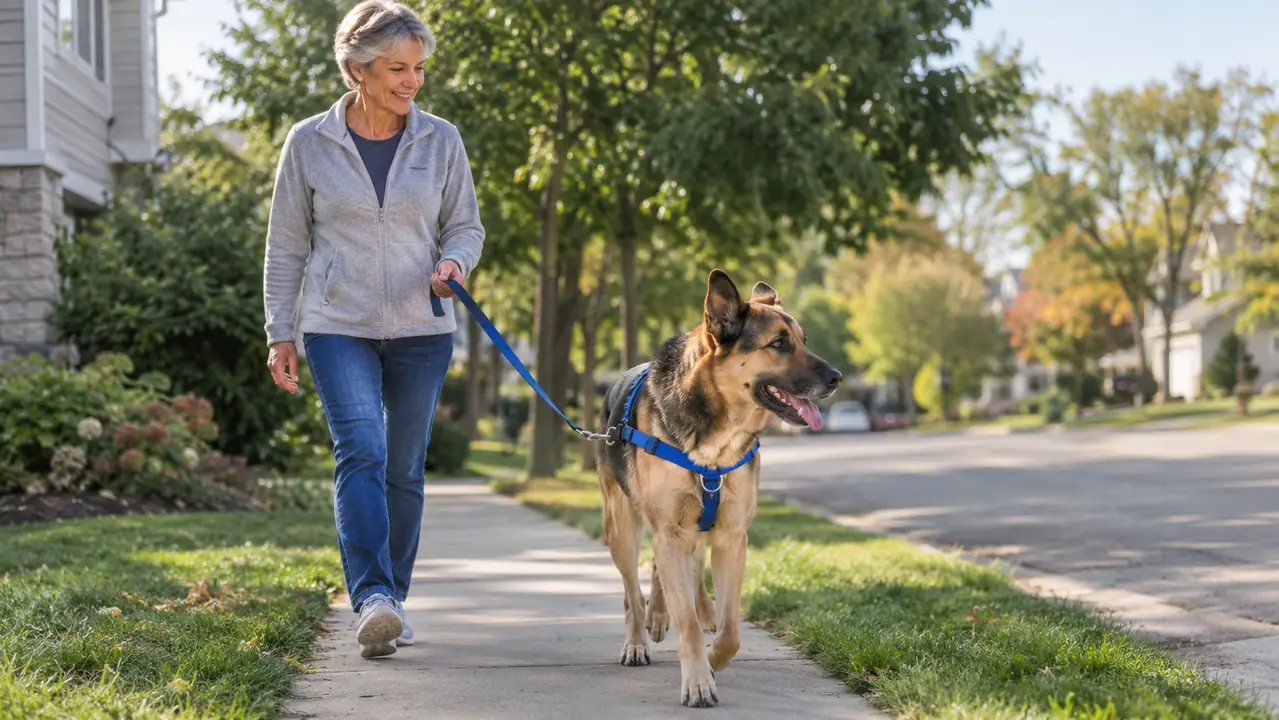
If you have a dog that pulls, you have probably stood in the pet aisle staring at two kinds of harnesses and wondering what the difference even is. I did the same thing two years ago, except I was standing there with Ridley, my 55-pound shepherd mix, who had just about dragged me across the parking lot. I bought a back-clip harness first because it looked comfortable and easy. Then I bought the PetSafe Easy Walk because a friend swore by it. I have now walked Ridley with both, every day, for long enough to know exactly what each one does and does not do.
The short answer: the PetSafe Easy Walk stops pulling because the leash clips at the chest, so when your dog surges forward the harness turns his shoulders instead of letting him lean into the pull. A back-clip harness clips behind the shoulders, which gives you more control on a calm dog but does almost nothing to stop a determined puller. If your dog pulls, the PetSafe Easy Walk is the one I would buy. If your dog walks politely already, a back-clip harness is fine and often more comfortable.
Stop the pulling at the source, not the collar
The PetSafe Easy Walk clips at the chest, so every forward surge turns into a gentle redirection. It is the harness that got Ridley and me out of the driveway without a wrestling match.
Amazon Check Today's Price on Amazon →How I Tested Both Harnesses
Ridley came to us from the shelter at about 18 months old, 55 pounds of muscle and anxiety. He pulled hard enough that our first walks were more like water skiing than walking. My husband Glen and I tried a flat collar, then a back-clip harness, then the PetSafe Easy Walk, and I kept notes the whole time because I am a retired school bus driver and I like data.
I used each harness for at least three weeks of daily walks, two walks a day, on the same routes through our neighborhood in Sun Prairie, Wisconsin. I rated how hard Ridley pulled, how often he stopped to sniff, whether the harness stayed put, and how easy it was to get on and off a dog who would rather be doing anything else. I also paid attention to how it felt on my shoulder, because I am 54 and my shoulder does not bounce back the way it used to.
I kept the conditions as similar as I could. Same neighborhood loop, same six-foot leash, same time of day, same pocketful of small training treats. I kept a little notebook by the door and wrote down how many hard pulls I counted on each walk and how my shoulder felt afterward. It is not science, but it kept me honest, because it is easy to remember the good walks and forget the bad ones.
One thing I want to be clear about: no harness is a training program. The PetSafe Easy Walk made walks manageable, but what actually changed Ridley's behavior was short daily training sessions in the kitchen and backyard, plus a lot of patience. The harness was the tool that let us do the training without me getting dragged down the street first.
The Big Difference: Where the Leash Clips
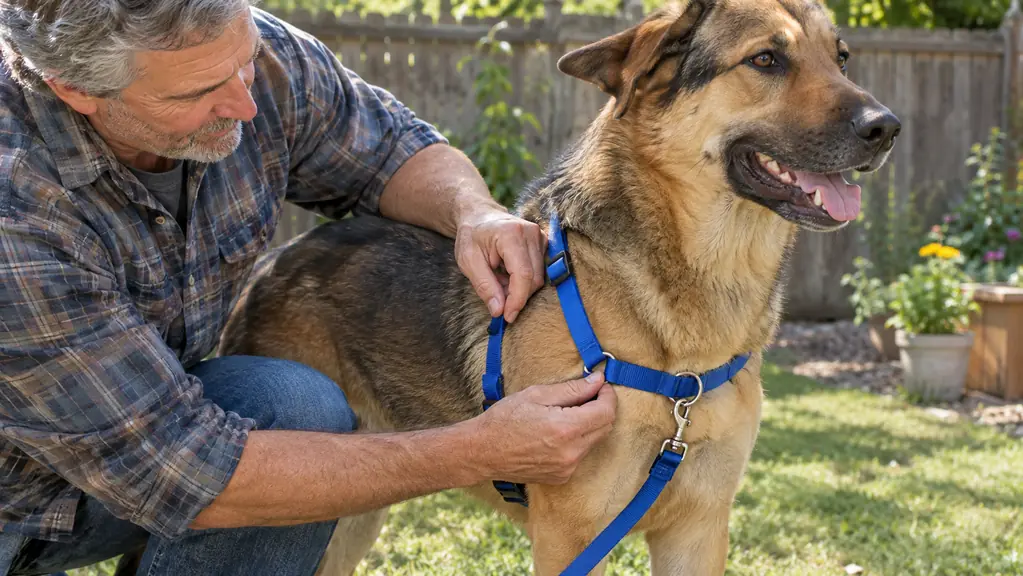
The PetSafe Easy Walk has the leash attachment at the chest, on a martingale loop that sits right across the breastbone. When Ridley surges forward, the harness gently turns his front end toward me instead of letting him pull straight ahead. He cannot get his weight behind the pull the way he can with a collar or a back-clip harness, so the pulling loses its payoff. That is the whole trick, and it is a good one.
A back-clip harness has the leash attachment on the back, between the shoulder blades. That is a great place for a calm dog because it spreads pressure across the chest and does not put anything on the throat. But for a puller, it is the wrong place. The dog can lean into the harness with his whole body, and you end up bracing against him. I have seen back-clip harnesses described as making pulling easier, and after three weeks of using one on Ridley, I believe it.
In practice, here is what that felt like with Ridley. On the back-clip harness, when a rabbit darted out from a hedge, he lunged and I had to plant my feet and lean back. His whole body lined up behind the pull, a bit like a sled dog. On the PetSafe Easy Walk, the same lunge swung his chest around toward me, and the pull lost most of its force before it reached my arm. One harness asked me to win a tug of war. The other quietly took the tug of war off the table.
| PetSafe Easy Walk | Back-Clip Harness | |
|---|---|---|
| Leash attachment | Front clip at the chest, turns the dog when he pulls | Back clip between the shoulders, lets the dog lean in |
| Pulling behavior | Surge turns the shoulders, pulling loses its payoff | Dog can brace and pull with his whole body |
| Comfort for calm dogs | Martingale loop across the chest, takes a walk or two to get used to | Soft padding, most dogs forget they are wearing it |
| Ease of putting on | Two buckles, easy once you learn the order | Step-in style, very easy |
| Best for | Dogs that pull on leash, reactive dogs, strong dogs | Calm walkers, puppies, dogs that already walk loose |
Where the PetSafe Easy Walk Wins
The PetSafe Easy Walk wins where it matters most for a dog like Ridley: it stops the pulling. The front clip means the harder he pulls, the more the harness turns him back toward me. It does not hurt him, it does not choke him, it just makes pulling useless. Within a few weeks, Ridley stopped throwing his whole body into the leash because it stopped working for him. That is the outcome I cared about, and it is the outcome the PetSafe Easy Walk delivered.
It also wins on control during the hard moments. When Ridley sees another dog and his brain leaves his body, the front clip lets me turn him in a circle and create distance without yanking on his neck. I can keep him beside me with a loose leash instead of bracing against a 55-pound dog who has decided he needs to say hello. For a reactive dog, that steering is the difference between a manageable walk and a miserable one.
That control also made me calmer, which I think Ridley noticed. When I felt like I could hold him, I stopped tightening up every time a dog appeared down the block. My hands stayed soft, my voice stayed normal, and he had less of my tension running down the leash to react to.
Where the Back-Clip Harness Wins
I am not going to pretend the back-clip harness has no strengths, because it does. For a dog that already walks politely, it is genuinely more comfortable. The padding sits nicely across the chest, nothing rubs under the armpits, and most dogs forget they are wearing it within a day. It is also easier to put on, especially the step-in style, because you are not threading a martingale loop over the head and then buckling two straps while a wiggly dog tries to eat a stick.
The back-clip design also distributes pressure evenly across the chest and shoulders when there is no pulling at all. For a dog who already walks nicely, it is very comfortable, and there is nothing at the chest that can swing or twist as the dog moves.
The back-clip harness also wins for casual use. If you have a senior dog who strolls, or a puppy who is still learning, the back clip is a perfectly good choice. It gives you a safe place to attach the leash without pressure on the throat, and it does not interfere with the dog's natural movement. I would not call it a mistake. I would call it the wrong tool for a puller, which is a different thing.
The harness that turned our walks around
Ridley still has his moments, but he does not drag me down the street anymore. The PetSafe Easy Walk is the reason we can take two peaceful neighborhood walks a day.
Amazon Check Today's Price on Amazon →
Who Should Buy Which
Buy the PetSafe Easy Walk if your dog pulls on the leash, if you have a strong dog and a tired shoulder, if your dog is reactive and you need to steer him away from triggers, or if you are starting training and want a tool that works with you instead of against you. It is the harness I recommend to anyone whose walks feel like a battle.
Buy a back-clip harness if your dog already walks with a loose leash, if you have a small or senior dog who does not pull, or if you just need a comfortable everyday harness for a dog who is already well behaved. You will not get the steering, but you also will not need it.
There is also a middle path that some people take: start with the PetSafe Easy Walk while you teach loose-leash walking, then move to a back-clip harness once the pulling is mostly gone. That is a perfectly reasonable plan, and it is roughly what I would suggest to a friend with a young dog who has not built the pulling habit as deeply as Ridley had.
What Nobody Tells You About the PetSafe Easy Walk
The PetSafe Easy Walk is not magic. It took Ridley a few walks to get used to the martingale loop across his chest, and the first time he tried to pull, the harness turned him so smoothly that he looked confused. That is the point, but it is also something you should expect. Give your dog a few short sessions in the yard before you attempt a full walk, and keep the chest strap snug enough that the harness cannot slip around.
I also want to be honest about the fit. The PetSafe Easy Walk comes in sizes, and getting the right one matters. The medium/large fits Ridley well, but I have heard from friends with deep-chested dogs that they needed to size up. Measure your dog before you order, and check the fit with the chest strap and the girth strap both snug but not tight. A harness that is too loose will not steer properly, and a harness that is too tight will rub.
The fit check I settled on takes ten seconds. Two fingers under each strap, chest strap low across the breastbone, belly strap a hand's width behind the front legs. If any of those is off, the front clip either slides to the side or rubs, and people blame the harness for what is really a fit problem.
The PetSafe Easy Walk did not train Ridley. It made training possible, because I was not being dragged down the street first.
The Bottom Line
If your dog pulls, the PetSafe Easy Walk is the better choice, and it is not close. The front clip turns pulling into a dead end, which is exactly what a 55-pound dog needs to learn. The back-clip harness is a fine product for a calm dog, but it will not fix a puller, and pretending otherwise just means more sore shoulders and frustrated walks.
Two years ago I could not walk Ridley to the end of the driveway without bracing. Now we do two neighborhood loops a day, and most of the time the leash hangs loose. The PetSafe Easy Walk is a big part of that, and it is the harness I would buy again tomorrow.
Give your shoulder a break and your dog a clear signal
The PetSafe Easy Walk clips at the chest, so every pull turns into a gentle redirect. It worked for a 55-pound shelter dog with a lot of opinions. It can work for yours.
Amazon Check Today's Price on Amazon →