
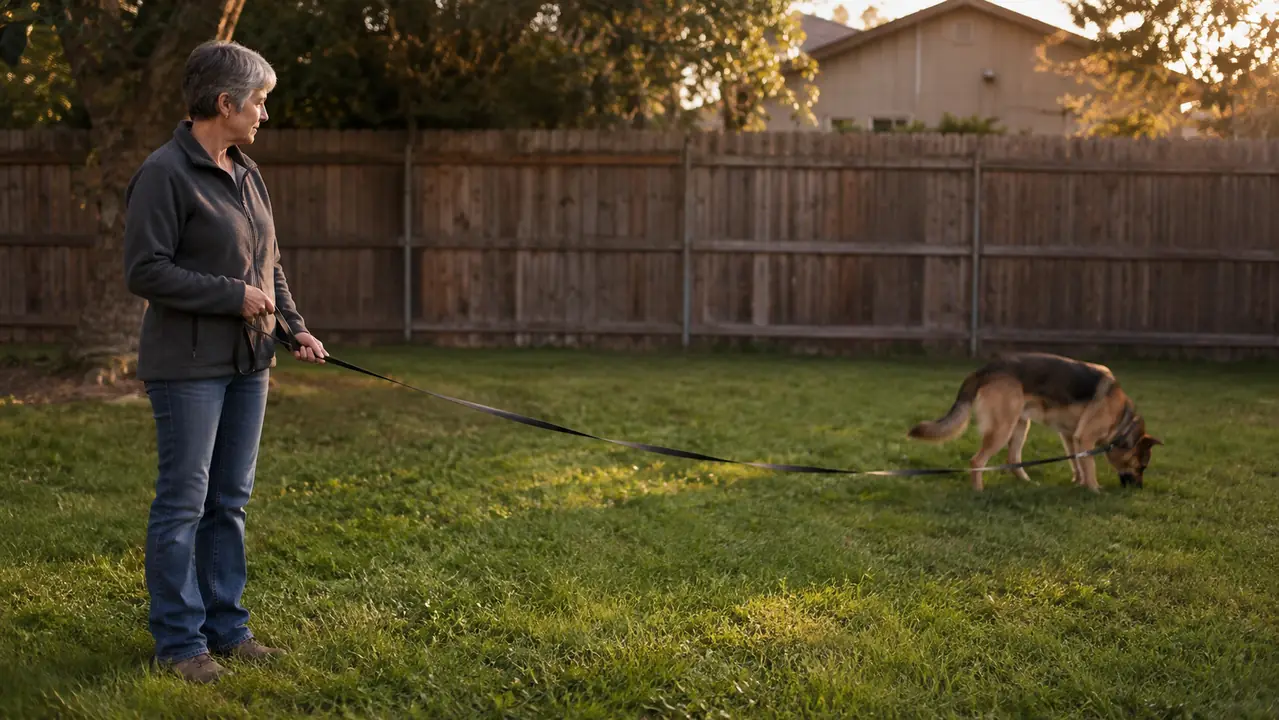
If you have a dog that sprints for the horizon the second the leash comes off, you already know the feeling. You stand in the yard with your heart in your throat, calling a name that is suddenly the most important word in the world, and the dog keeps going. That was me and Ridley for the first year we had him. He is a 55-pound shepherd mix, about four years old now, and when he came to us from the shelter he had exactly one speed outdoors: gone. I tried the usual things. I tried a retractable leash and hated every minute of it. I tried letting him drag a regular six-foot leash, which was useless. Then I bought a Hi Kiss long training leash, the 20-foot orange one, and I want to tell you what a year of regular recall practice with it actually looked like.
The Quick Verdict
The Hi Kiss long training leash is the single most useful training tool I own. It gave Ridley real freedom in the yard while keeping a safety line I could actually grab. It will not teach your dog to come by itself, but nothing will. What it does is give you the practice space to teach it.
Amazon Check Today's Price →Give your dog real freedom with a line you can still grab
The Hi Kiss long training leash turns a fenced yard into a recall classroom. Ridley gets to explore, I get a safety net, and we both get the practice we need. Check today's price on Amazon and see if the 20-foot length fits your space.
Amazon Check Today's Price on Amazon →How I've Used It
I want to be clear about what this leash is and is not. It is not a magic fix. It is a 20-foot length of lightweight nylon webbing with a handle on one end and a clip on the other. You attach it to the back ring of Ridley's harness, let him wander, and you hold the handle. That is the whole design. The point is that he gets to be twenty feet away from me, which is far enough to feel like freedom to a dog, but I still have the other end in my hand. When he was younger and less trustworthy, that handle was the difference between a training session and a trip to the county line.
We used it almost every day for a year. In the beginning, I would take Ridley to the backyard, clip on the long line, and just let him walk to the end of it. I did not call him. I let him sniff and wander and get used to the feeling of the line trailing behind him. Then I would say his name in a happy voice, and the second he turned toward me, I would jog backward a few steps and reward him when he caught up. We did this for maybe five minutes at a time, twice a day. It sounds almost too simple to work, but it is the foundation of everything else we did.
After a few weeks, I started using the line to practice recall in the front yard, where the distractions were bigger. Cars, neighbors, the mail carrier. Ridley would get to the end of the 20 feet, and I would call him, and sometimes he would come and sometimes he would just stand there looking at me like I had asked him to solve a math problem. On the days he did not come, I did not reel him in like a fish. I walked out to him, clipped the line shorter, and tried again closer. The Hi Kiss leash made that easy because the handle is big enough to grab at any point along the line, so I could shorten it to ten feet, then five, without unclipping anything.
What the 20-Foot Length Actually Feels Like
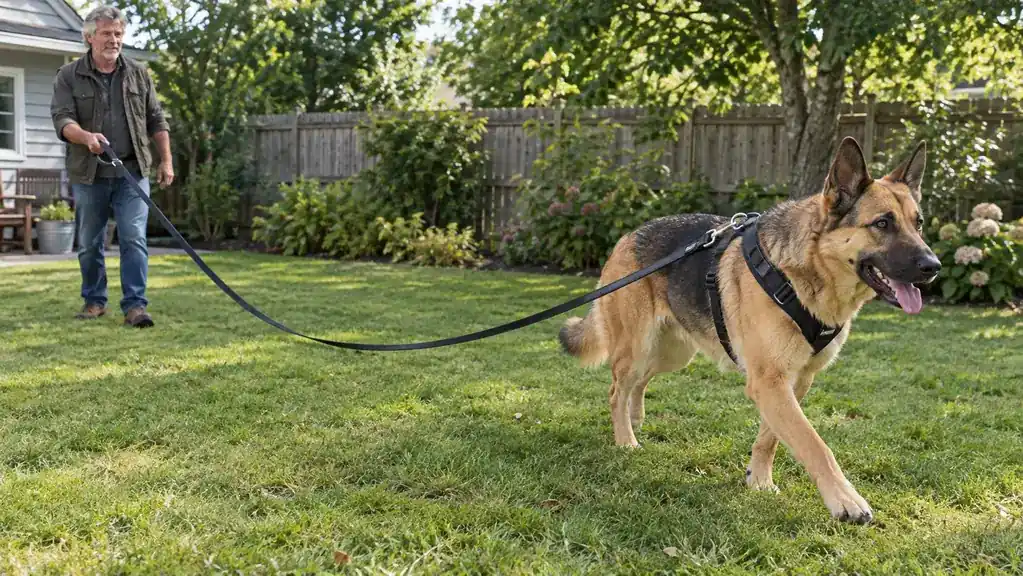
The 20-foot version is the one I recommend for most people, and here is why. A 15-foot line is fine for a small yard, but it does not give a dog like Ridley enough room to feel like he is actually exploring. A 30-foot line is wonderful in an open field, but it is a lot of rope to manage in a normal backyard, and it tangles around bushes and fence posts constantly. Twenty feet is the sweet spot. It is long enough for Ridley to trot to the far end of the yard, sniff the fence line, and feel like he made a decision on his own. It is short enough that I never felt like I was wrangling a garden hose.
The material matters more than I expected. The Hi Kiss line is a flat nylon webbing, not a round rope. That flat shape is what keeps it from twisting into knots the way a round cord does. Ridley stepped on it, rolled on it, dragged it through wet grass, and I still only had to untangle it a handful of times. The handle is a padded loop at the end, which sounds like a small thing, but when you are holding a line for a twenty-minute training session, a handle that does not dig into your hand is the difference between finishing the session and quitting early.
One thing I will say honestly: the clip is functional but not fancy. It is a standard metal swivel clip that has held up fine for a year of regular use, including plenty of rain and snow. It has never opened on its own, and it has never rusted. But it is not a heavy-duty mountaineering carabiner. If you have a dog that lunges hard at the end of the line, you will want to watch the clip and the stitching over time. For normal recall practice, it has been more than adequate.
How We Built Recall From the Ground Up
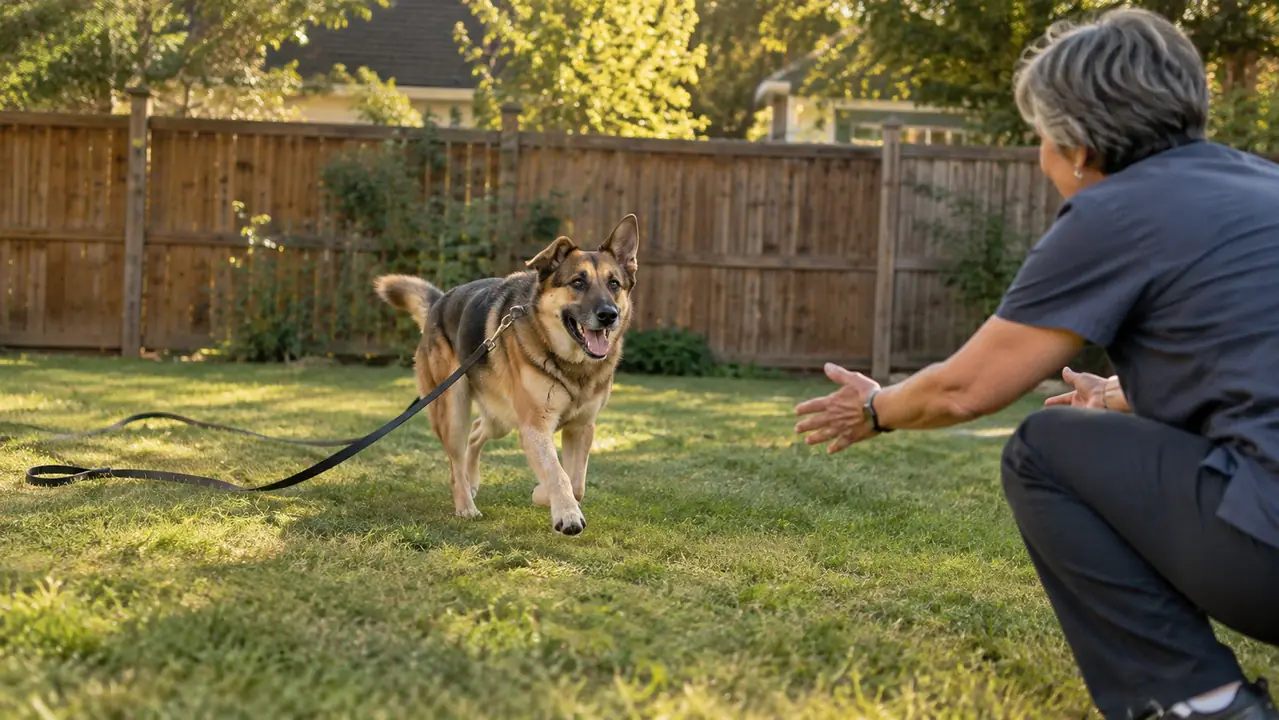
The long line is a tool, but the real work is the game you play with it. Here is the exact routine that worked for us. I started in the backyard with zero distractions. I would let Ridley wander to the end of the line, then call his name once, in a voice that sounded like I was about to produce a piece of chicken. The second he turned his head, I would jog backward a few steps. Dogs naturally follow movement, so jogging backward made coming to me feel like a game instead of an interruption. When he reached me, he got a small piece of chicken and a lot of praise. Then I would let him go again. That was the whole session. Five minutes, twice a day.
The key was that I never used the line to drag him to me. If I had, he would have learned that the line means being pulled, and he would have avoided the line. Instead, the line was just there, a quiet safety net. He learned that coming to me was always a good thing, and that he could always go back out and explore again. That last part matters. If every recall ends the fun, your dog learns that coming when called means the party is over. So sometimes I would call him, give him his treat, and then say 'go play' and let him run to the end of the line again. He learned that checking in with me did not cost him anything.
After about two months, we moved the game to the front yard. That was a bigger test. There were cars, bicycles, and the occasional neighbor walking a dog. I kept the sessions short and I kept the line in my hand the whole time. When Ridley chose to come back to me with a bicycle rolling past, I made sure he got the best treat in the house. By month four, I could see a real change. He would be at the end of the line, ears up, watching the world, and the second I called his name, his head would swing around and he would start moving toward me. Not always in a straight line, and not always at a sprint, but he was coming.
By month four, Ridley was at the end of the 20-foot line, and when I called his name, he turned and came back to me with a bicycle rolling past. That was the moment I knew the long line was working.
The Difference Between a Long Line and a Retractable Leash
People ask me why I did not just use a retractable leash, and the answer is simple. A retractable leash keeps constant tension on the dog. The dog feels the cord pulling against his neck the whole time, and many dogs, especially dogs with any leash sensitivity, learn to lean into that pressure. A long line lies on the ground. There is no tension unless the dog reaches the end of it. That changes the whole conversation. With the Hi Kiss line, Ridley learned that he could move freely and that the only time he felt any pressure was if he hit the end of the line, which was his own choice. That is a much better lesson for a dog who came to me with a habit of pulling.
There is also a safety difference. A retractable leash has a thin cord that can cause serious rope burn if a dog bolts and hits the end at speed. It can also break, and when it breaks, the dog is gone with no handle in your hand. The Hi Kiss line is a flat, wide webbing that is much easier to grab and hold. If Ridley ever hit the end of the line at full speed, I could brace myself and hold on without worrying about the line cutting my hand. That peace of mind is worth a lot when your dog weighs 55 pounds and has a strong prey drive.
I will also say this: the long line is not a substitute for a solid fence. I used it in my fenced backyard and in open spaces where I knew the area was safe. The line is a training tool, not a tether for leaving your dog unattended. You should never tie a dog out on a long line and walk away. The whole point is that you are holding the other end, paying attention, and practicing together.
What I'd Change If I Could
No product is perfect, and I want to be straight with you about the things that bugged me. The first is the clip. As I said, it has held up, but it is the least impressive part of the leash. It is a standard swivel clip, and on a 20-foot line, it is small relative to the length. I would love to see a slightly beefier clip with a smoother swivel, because the line does twist a little when Ridley circles around me, and the swivel is what works that twist out.
The second thing is the color. The orange is actually a good choice for visibility, and I have never lost the line in the grass, which is more than I can say for a green line I tried once. But the orange does show dirt. After a year of backyard use, the line is a little grubby. It still works perfectly, and it is machine washable, which I did not expect. I threw it in a laundry bag on a gentle cycle and it came out looking almost new. So this is a minor complaint, not a real problem.
The third thing is that the line can be a tripping hazard if you are not paying attention. When Ridley circles me, the line can wrap around my ankles. I learned to keep my feet moving and to step over the line when he changed direction. This is true of any long line, not just this one, but it is worth knowing before you buy.
What I Liked
- Flat nylon webbing does not twist into knots the way round rope does
- Padded handle is comfortable to hold for long training sessions
- 20-foot length is the right balance of freedom and control for a backyard
- No constant tension, so it teaches a dog to move freely without pulling
- Easy to grab at any point to shorten the working length
- Machine washable and quick to dry
Where It Falls Short
- Clip is functional but not heavy-duty; watch it with hard lungers
- Orange color shows dirt over time
- Line can wrap around your ankles when the dog circles you
- Not a tie-out; you have to hold the handle for it to be useful
Who This Is For
The Hi Kiss long training leash is for the owner who is willing to put in five minutes a day, twice a day, and who wants a tool that makes those minutes count. It is for the person with a fenced yard who wants to give their dog more freedom without losing the safety net. It is for the owner of a young dog, a newly adopted dog, or a dog whose recall has never been tested, because it lets you practice in a space where failure is not dangerous. It is for anyone who has ever stood in a field calling a dog's name and felt that cold panic when the dog kept going. I have been that person. This leash is the reason I am not that person anymore.
Who Should Skip It
If you are looking for a tool that will stop your dog from pulling on a normal walk, this is not it. The long line is for training space, not for walking down the sidewalk. For that, you want a good front-clip harness and a standard six-foot leash. If you have a dog that is already a serious escape artist, one who chews through leashes and lines, you will want to supervise the long line closely, because a determined chewer can damage the webbing. And if you are not going to hold the handle, if you were hoping to clip the line to a stake and let the dog roam, skip this and buy a proper tie-out instead. The Hi Kiss line is a training tool, and it only works when you are part of the session.
Six months of recall practice, one simple tool
Ridley went from a dog who would bolt for the horizon to a dog who turns and comes when I call, even with a bicycle rolling past. The Hi Kiss long training leash was the tool that made that practice possible. See today's price on Amazon and start your own five-minute sessions.
Amazon Check Today's Price on Amazon →