

When Ridley came home from the shelter, I bought a retractable leash because it seemed like the flexible option. Then I spent the next year learning why trainers keep reaching for a long line instead. This is the comparison I wish someone had walked me through back then: the Hi Kiss long line versus a retractable leash, both used for real recall training with a 55-pound shepherd mix who had zero interest in coming when called.
At the time it seemed like the kind thing to do. He had spent months in a kennel, and I wanted him to have room to explore. What I did not understand yet was that the kind of room a dog gets matters as much as how much of it he gets. A leash that rewards pulling and a leash that teaches coming back can be the same length and teach completely opposite lessons.
The short answer: for teaching a dog to come back to you, the Hi Kiss long line wins. A retractable leash is fine for a relaxed stroll with a dog who already has solid recall. It is not a training tool for a dog who is still learning, because it teaches the opposite of what recall training needs. Here is the full breakdown.
I used the retractable for about two months before I gave up on it, and the Hi Kiss long line for recall work in the backyard and at a quiet park after that. Same dog, same neighborhood, same treats in my pocket. The difference in what Ridley learned was bigger than I expected from two pieces of gear that, on paper, both just let a dog go farther away from you.
| Hi Kiss Long Line | Retractable Leash | |
|---|---|---|
| Price | One flat price for a 20, 30, or 50 foot line | Comparable price, but the mechanism adds parts that can wear out |
| Tension on the dog | Line goes slack when you let it, so the dog feels no constant pull | Mechanism keeps light tension on the line at all times |
| What it teaches | Dog learns that coming back releases pressure and earns freedom | Dog learns that pulling away is rewarded with more line |
| Control in an emergency | You can grab the line anywhere and shorten it instantly | You must press the lock button and reel in, which takes seconds |
| Best for | Recall training, hiking, camping, and backyard sessions | Casual walks with a dog who already has reliable recall |
Where the Hi Kiss Long Line Wins
I want to start with recall, because that is the reason most people look at a long line in the first place, and it is the job where the difference between these two leashes is clearest.
The biggest difference is what the dog feels. A retractable leash keeps a constant light tension on the line because of the spring mechanism. That tension is exactly what a dog learns to lean into. When Ridley felt that pull, he pulled harder. The Hi Kiss long line goes slack the moment I let it, so Ridley learned that the pressure only came back when he hit the end of the line. That single change made more difference in our training than any treat strategy I tried.
With the retractable, Ridley learned that pulling made the leash longer. Every time he leaned into it, the cord fed out a few more feet, so pulling literally paid off. That was the opposite of what I was trying to teach him on our regular walks. On the Hi Kiss line, slack is slack. Nothing happens when he pulls except that he runs out of line, so pulling stops being a winning strategy.
The second thing a long line does well is give a clear, quiet moment for a recall. When Ridley was sniffing twenty feet away and I called him, the line lay loose on the grass. If he turned and came, wonderful. If he did not, I could gather the line in calmly and help him finish the recall instead of repeating his name ten times while he ignored me. That is how a recall stays reliable: he never gets to practice ignoring it.
The Hi Kiss line is also just a simpler tool. There is no handle mechanism to fail, no button to fumble, no tape that can tangle. It is a flat length of strong nylon with a padded handle and a clip. I can grab it at any point to shorten it, which matters when Ridley spots a squirrel and I need to close the distance fast. With a retractable, I had to find the lock button, press it, and reel in while he was already committed to the chase. That extra second is the one you do not have.
There is a safety side to this too. Retractable leashes carry warnings for a reason. The thin cord can burn skin or wrap around legs, and if you drop the bulky handle, it can clatter along the ground behind a dog and frighten him into running faster. I dropped ours once when Ridley lunged at a cat, and the sound of the handle chasing him down the sidewalk set his training back for weeks. A flat webbing line that you drop just lies there.
The Hi Kiss lead comes in several lengths, from 15 feet up to 100 feet. For most backyard and park recall work, 15 to 30 feet is plenty. The really long lengths are for big open fields, and they take more skill to handle without tangles.
The training tool that taught my rescue to come back
The Hi Kiss long line gives you slack when you want it and control when you need it. It is the leash I reach for every single training session.
Amazon Check Today's Price on Amazon →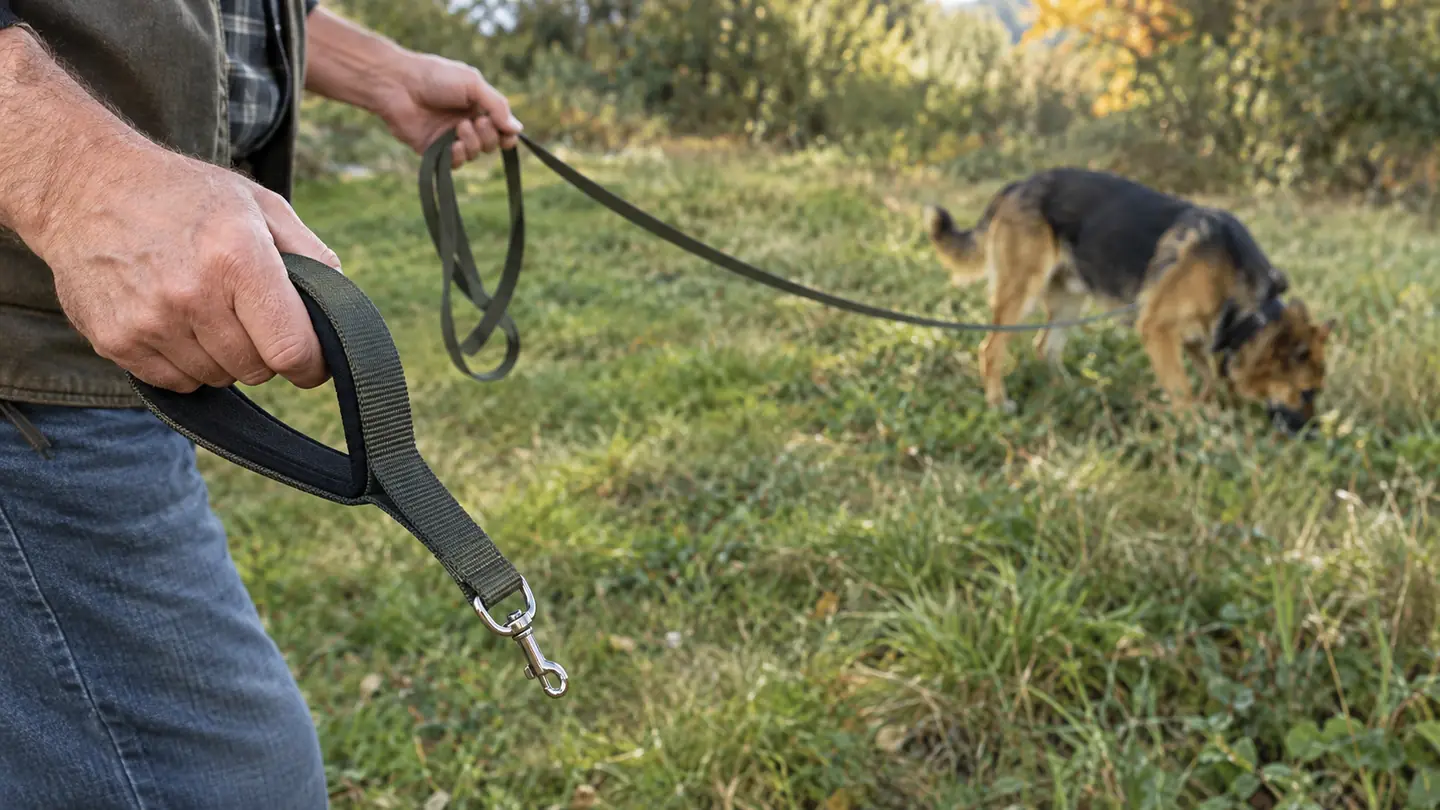
Where the Retractable Leash Wins
I am not going to tell you retractables are useless, because that is not true. For a dog with reliable recall, on a quiet sidewalk, a retractable leash lets you give your dog a little more freedom without carrying a long line. My neighbor uses one with her senior beagle, and it works fine for them. The dog does not pull, she does not need to train anything, and the retractable keeps the walk relaxed for both of them.
They are also compact. The whole leash winds into a handle that fits in a coat pocket or a cup holder, and there is nothing to coil, rinse or hang up to dry. For someone who walks a calm, well-trained dog on quiet suburban streets, that tidiness is genuinely nice.
If your dog already has a solid recall and good leash manners, a retractable can be a pleasant way to let him wander a bit on a quiet trail. The trouble is that most people buy a retractable for a dog who does not have those skills yet, and it tends to make the problems worse instead of better.
Retractables also win on convenience in tight spaces. You can lock the line at two feet to cross a street, then let it out again on the path. A long line has to be gathered up by hand, and if you are not paying attention, it drags through puddles and picks up burrs. I keep a retractable in the car for the rare occasions when I want a short walk with no training agenda. But I never use it for recall work, because it cannot do what the Hi Kiss line does.
A long line does take more management. Twenty feet of webbing has to go somewhere, and in a parking lot or on a crowded path it is too much leash. I keep a regular six-foot leash for neighborhood walks and switch to the Hi Kiss line only when we get to the park or the backyard. It adds a minute to the routine, and it keeps each tool doing the job it does best.
How I Handle a Long Line Without Tangles
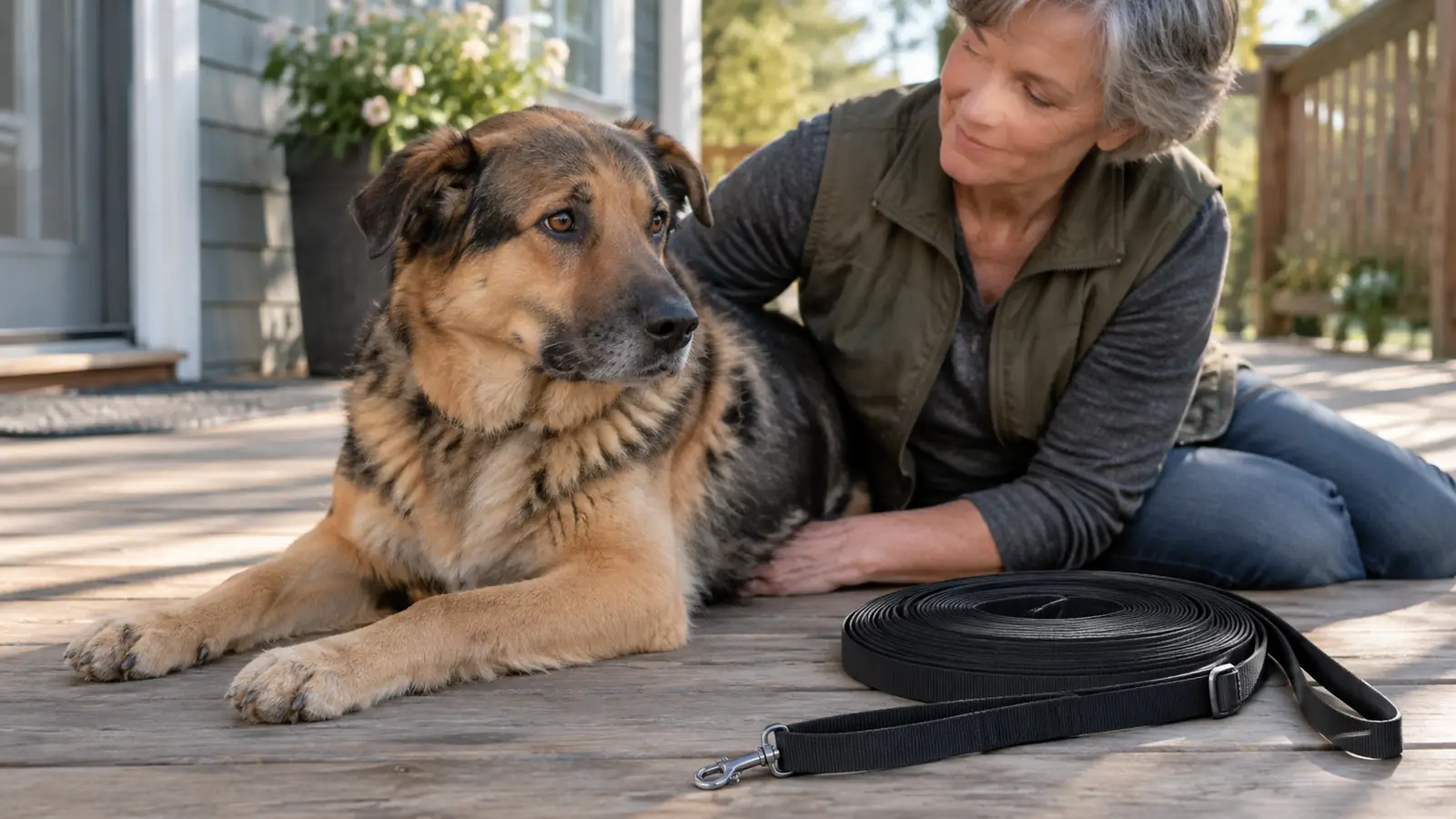
The first few sessions with the Hi Kiss line were clumsy. The line wrapped around my ankles, caught on a bench leg, and once went around Ridley's back leg when he circled me. None of that was the leash's fault. Long lines take a little technique, and once I learned it, the tangles mostly stopped.
It helped to remember that Ridley was learning too. The first few times he reached the end of the line, he was surprised. After a week, he started checking in on his own as he got close to the end, glancing back at me as if to ask how far he could go. That habit of checking in is a big part of what a good recall is built on.
Here is what works for me. I hold the handle in one hand and gather the extra line in loose loops, never wrapped around my hand or fingers. As Ridley moves away, I let the loops go one at a time. When he comes back, I gather them in again. In a big open space, I sometimes let the line simply drag on the ground so it is there if I need to step on it. I always clip it to his harness, never his collar, so if he hits the end of the line at a run, the force lands on his chest and not his neck.
I also wear light gloves in cold or wet weather. Wet webbing slides fast, and a pair of gardening gloves makes it easy to slow the line without a rope burn. After muddy sessions, I rinse the line in the laundry sink and hang it over the shower rod to dry, and it is ready the next morning.
Finally, I pick the place carefully. A long line belongs in a fenced yard, an empty ball field, or a quiet corner of a park with good sight lines. It does not belong near a road, on a busy trail, or anywhere bikes and joggers pass close by. Choosing the spot well prevents most of the problems before they start.
Who Should Buy Which
Buy the Hi Kiss long line if you are teaching recall, if your dog pulls, if you want to practice in a backyard or field, or if you simply want a leash that will not break mid-walk. It is the tool for the work. Buy a retractable leash only if your dog already comes when called every time, and you want a little extra freedom on casual walks. If you are still in the training phase, the long line is the honest answer.
Buy a retractable only if your dog already walks nicely and comes reliably, and you want a casual way to give him more room on quiet trails. Even then, lock it to a short length near roads and people.
For Ridley, the long line was the bridge between a dog I could not trust off leash in the backyard and a dog who turns and runs to me when I call his name across a field. The retractable never got us any closer to that.
If you only buy one of these for a dog who is still learning to come when called, make it the long line. It is the tool that teaches, and everything else gets easier once your dog believes that running back to you is the best idea he has all day.
Start recall training the way trainers actually do
A long line is the first tool in any real recall program. The Hi Kiss line is affordable, durable, and long enough for real practice.
Amazon Check Today's Price on Amazon →