
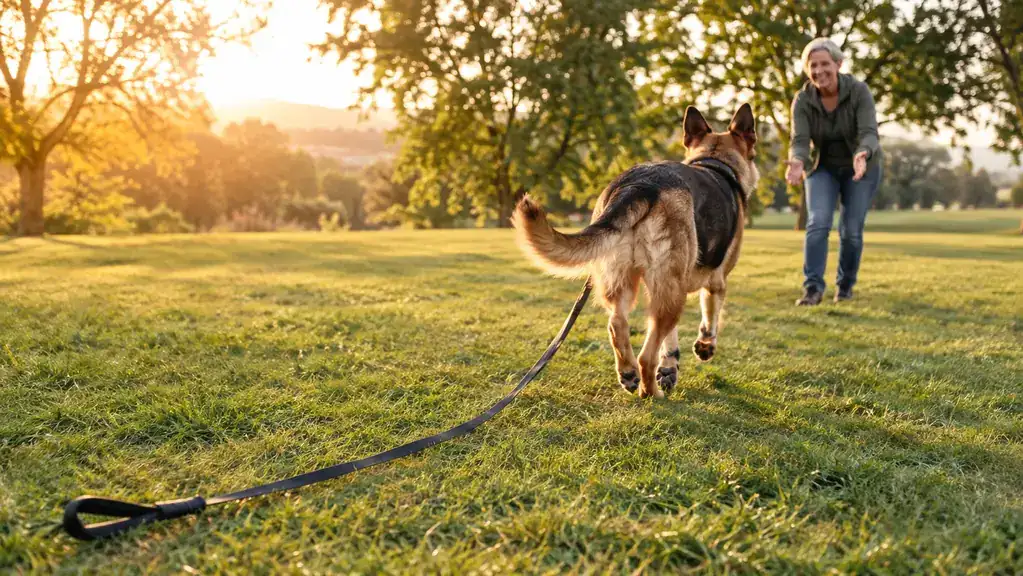
The day it happened, I almost didn't believe my own eyes. We were at the far end of the park, Ridley on the Hi Kiss 20-foot training leash, and a squirrel shot across the path about fifteen feet ahead of him. Two years earlier, that squirrel would have meant a yanked shoulder, a barking fit, and me apologizing to every person in earshot. Instead, Ridley froze, looked back at me, and waited. I said his name, patted my leg, and he came trotting back like it was the most natural thing in the world.
I'm Carla Brennan. I live in Sun Prairie, Wisconsin, with my husband Glen and a shepherd mix named Ridley who came to us from the shelter at about eighteen months old. He was 55 pounds of pure chaos: he pulled until he choked, lunged at other dogs, and panicked the second I closed the front door. I spent his first year convinced I had adopted a dog who would never be safe off a leash. I was wrong, but it took a long time and the right tool to prove it.
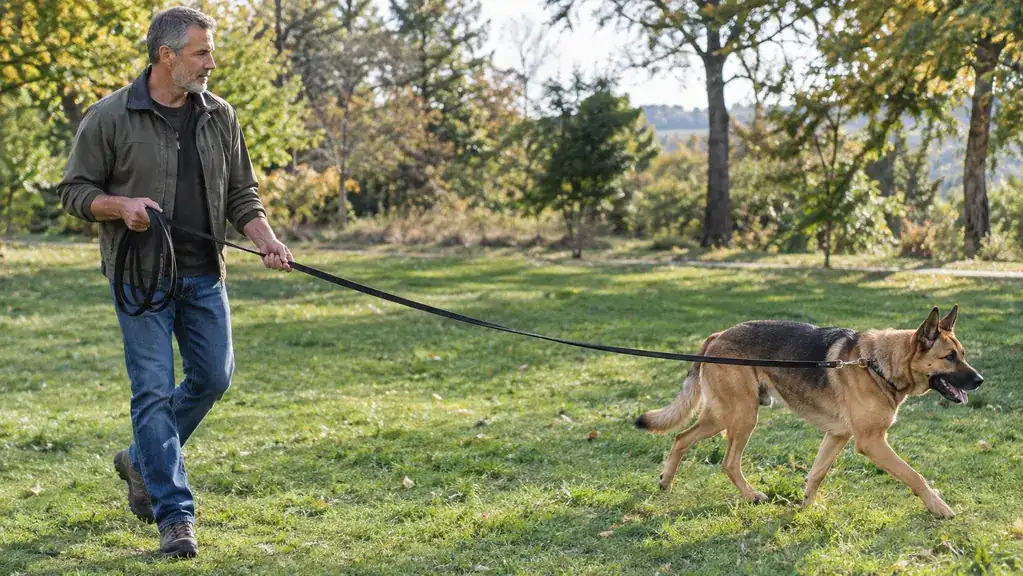
The tool was a 20-foot training leash from Hi Kiss. Not a retractable leash, which I'll get to in a minute, but a long, flat line that let Ridley roam and explore while I kept a hand on his safety. It cost less than a pizza, it has held up through two Wisconsin winters, and it is the reason I can now stand in a park and watch my dog make a good choice instead of a panicked one.
This is not a story about a dog who was born perfect or a piece of gear that did the work for us. It's a story about what happens when you give a scared, reactive dog a way to practice being brave, a little bit at a time, with a safety net he can't see. The Hi Kiss leash was that safety net. Here's how we got from the end of my driveway to that moment in the park.
The leash didn't train Ridley. It gave him the room to learn that coming back to me was always the safest choice.
Give your dog the same room to learn
A 20-foot Hi Kiss training leash gives your dog space to explore while you keep control. It's the same tool I used every single day with Ridley.
Amazon Check Today's Price on Amazon →When Ridley first came home, our walks were a disaster. He'd hit the end of a six-foot leash so hard he'd cough, then spin around and bark at whatever had startled him. I tried a harness, a head collar, a shorter leash, a stiffer leash. Every one of them just gave us a different way to fight each other. What I didn't understand was that Ridley wasn't trying to be difficult. He was terrified, and the only skill he had was to get away from the scary thing as fast as he could.
A trainer friend finally explained it to me in words I could use: a dog who is always at the end of a tight leash never learns that he can choose to come back. He only learns that the world is full of things that make him choke. She suggested I try a long line, something that would let Ridley feel distance and freedom while I still held the other end. I ordered the Hi Kiss 20-foot leash that same week.
The first time I unclipped his regular leash and clipped on the long line, I was terrified. Twenty feet felt like no control at all. But the Hi Kiss leash has a comfortable handle and a swivel clip that never once twisted up on itself, and the flat webbing was easy to gather back in when I needed him closer. We started in the backyard, then moved to the empty end of the park, then to the path by the creek. Every session was short, maybe ten minutes, and every session ended with me calling his name and rewarding him the second he turned toward me.

The change was not overnight. It was a hundred small moments: Ridley glancing back at me instead of bolting, Ridley choosing to sniff a bush instead of fixating on a dog across the field, Ridley sitting down and waiting when he wasn't sure what to do. The Hi Kiss leash made all of it possible because it gave him a bubble of safety that grew a little bigger every week. He could make a mistake, feel the gentle stop of the line, and realize the world didn't end.
By the time the squirrel ran across that path, Ridley had been wearing the Hi Kiss leash for about a year. He still wore it on every walk, even though he no longer needed it the way he once did. It was our ritual, our reminder of how far we'd come. And when he came trotting back to me that afternoon, tail loose and easy, I knelt down, gave him the treat I always carried, and told him he was the best dog in Wisconsin. I meant it.
What I'd Tell You If We Were Sitting at My Kitchen Table
If you have a dog who pulls, who panics, who you're afraid to let off leash, here is what I'd say over coffee: you don't need a perfect dog to start. You need a safe way to practice. A long training leash like the Hi Kiss gives you that. It is not a shortcut and it will not do the training for you, but it will let you and your dog show up every day and try again. That is more than half the battle.
Start in a boring place. Use high-value treats. Keep sessions short. Call your dog's name and reward the moment he turns toward you, even if he doesn't come all the way. And when he does come, never punish him for taking his time. The goal is to make coming back to you the best thing that happens in his day, every single time.
I am not a trainer and I don't pretend to be one. I'm a retired school bus driver who loved a difficult dog and kept notes. If you're struggling, find a positive-reinforcement trainer in your area and get their eyes on your dog. But if you just need a tool that lets you start, the Hi Kiss long training leash is the one I'd hand you across the table. It gave Ridley room to become the dog he was always trying to be, and it can do the same for yours.
Start with twenty feet of room to learn
The Hi Kiss 20-foot training leash is the same tool I used with Ridley every day. Check today's price on Amazon and give your dog the gift of a longer leash and a shorter path to trust.
Amazon Check Today's Price on Amazon →