
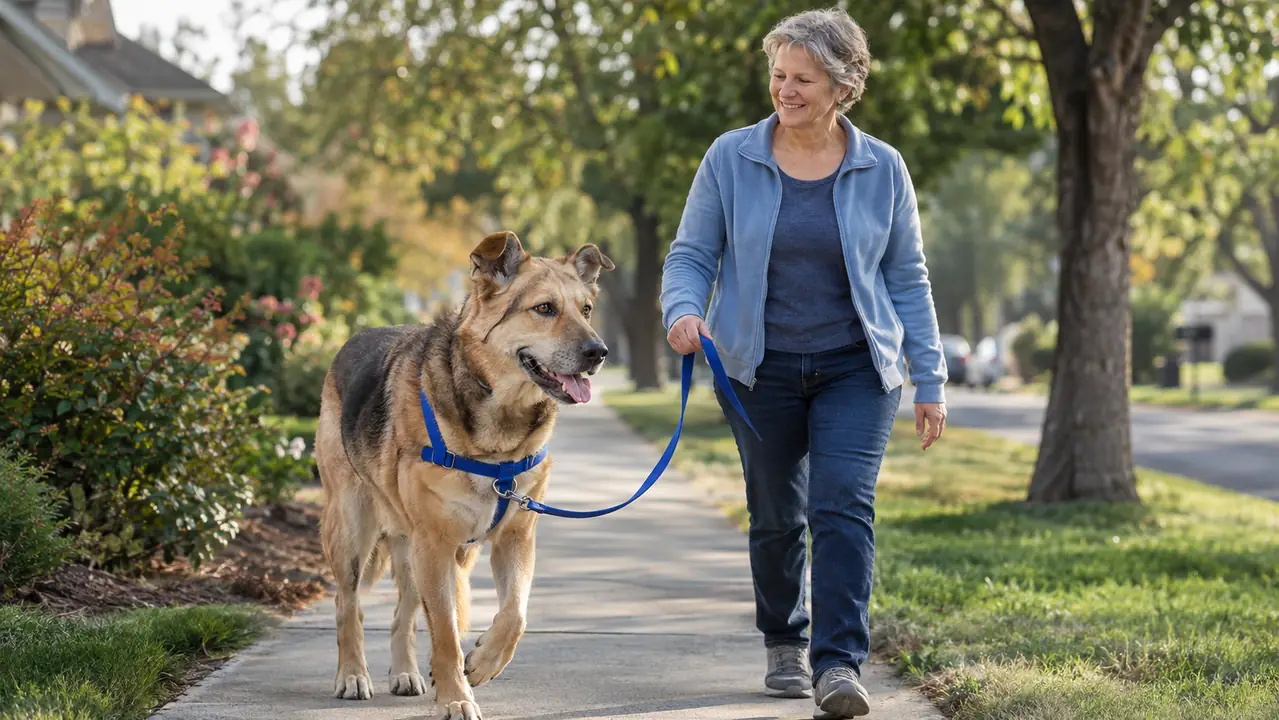
If you are reading this because your shoulder aches after every walk, I want you to know something first: you are not a bad dog owner, and your dog is not stubborn. Pulling is the most common complaint I hear from people in my neighborhood, and I used to be one of them. My dog Ridley, a 55-pound shepherd mix I adopted at about 18 months, came home convinced that the entire point of a walk was to get to the end of the leash as fast as possible. I tried the usual things. I stopped walking when he pulled. I turned around. I talked to him in a calm voice while my arm slowly stretched. None of it worked, because I was asking him to do something he did not understand while the gear I was using made it harder, not easier.
What finally worked was a combination of two things: a front-clip no-pull harness that made pulling physically unrewarding, and a short daily training routine that taught Ridley what I actually wanted instead. The harness we used is the PetSafe Easy Walk, and this guide is the exact plan we followed. It is not a quick fix. It took Ridley about six weeks to walk politely on a loose leash most of the time, and he still has off days. But the change was real, and it started the day I stopped fighting the pull and started redirecting it.
Start with the harness that made loose-leash walking possible for us
The PetSafe Easy Walk clips at the chest, so pulling turns the dog gently back toward you instead of dragging you forward. It is the first piece of gear I recommend to anyone whose walks end with a sore arm.
Amazon Check Today's Price on Amazon →Step 1: Fit the harness properly before you touch the leash
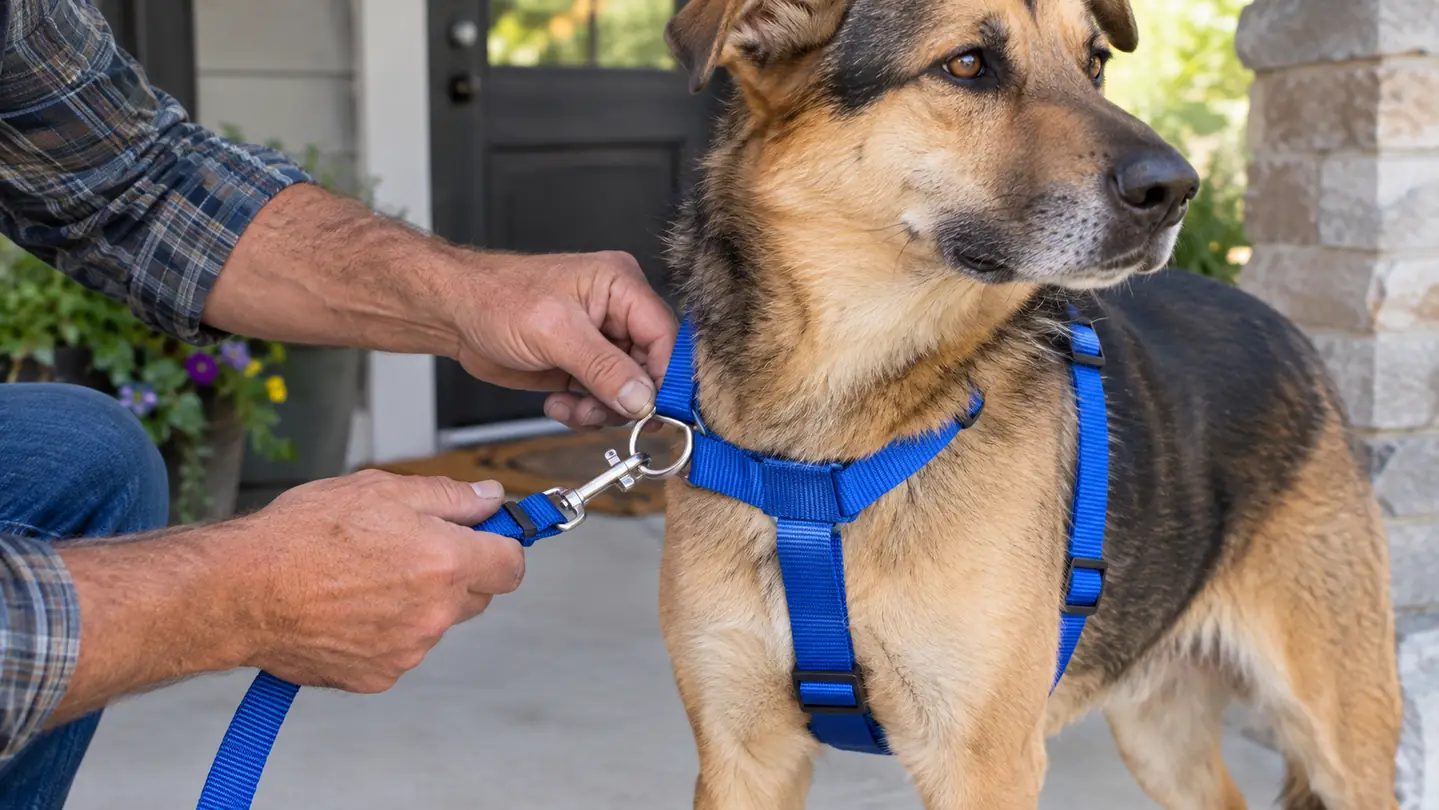
A no-pull harness only works if it fits, and most of the frustration people blame on the harness is actually a fit problem. The PetSafe Easy Walk has two adjustment points: the strap that goes around the chest and the strap that goes behind the front legs. When it is right, the chest strap sits high, across the breastbone, not down low where it can rub the elbows. You should be able to slide two fingers flat under any strap, but not much more. If the harness is loose enough to shift sideways, the front clip ends up under the armpit and the steering effect disappears.
I made this mistake with Ridley at first. I left the chest strap a little loose because I felt guilty about anything snug, and the harness slid around so much that he could pull almost as hard as he did with his old flat collar. The day I tightened it to sit high on his chest was the day the walk changed. The front clip stayed centered, and every time he lunged forward, the harness turned his front end back toward me. He was not being punished. He was just discovering that pulling no longer got him where he wanted to go.
Take a few minutes to fit the harness indoors before your first walk. Let your dog wear it around the house for ten or fifteen minutes while you give treats for calm behavior. This is not wasted time. A dog that is comfortable in the harness can focus on learning. A dog that is distracted by a rubbing strap is learning nothing.
Step 2: Teach your dog that a loose leash is the only leash that moves
The core lesson is simple, but it takes repetition: the walk only continues when the leash is loose. The moment the leash tightens, you stop moving and become a tree. No yanking, no scolding, no eye contact. You just stand still and wait. The instant your dog looks back at you or takes a step that slackens the leash, you mark it with a cheerful word and start walking again.
This is the part where most people give up too early, and I understand why. The first few sessions feel like you are walking ten feet and stopping twenty times. That is normal. You are not failing. You are teaching a brand new behavior, and the stops are the lesson. What matters is consistency. If you stop every single time the leash tightens, your dog learns the rule in days. If you stop sometimes and let it slide other times, you are teaching him that pulling might work, which means he will keep trying it.
With the PetSafe Easy Walk, this step is easier because the harness does part of the work. When Ridley hit the end of the leash, the front clip turned his chest back toward me, so his own momentum brought him around. He did not need me to correct him. The harness did the redirecting, and I just had to stay still and wait for him to figure out that forward motion came from the loose leash, not the tight one.
Step 3: Use treats to build a new habit, not to bribe
Once Ridley understood that a tight leash stopped the walk, I added the second half of the lesson: walking next to me is its own reward. I carried a small pouch of soft treats on every walk for the first month. Every time he chose to walk beside me with a slack leash, I marked it with a word and gave him a treat. I did not lure him along with food held in front of his nose. I rewarded the choice when he made it on his own.
The distinction matters. A lure teaches your dog to walk with his nose glued to your hand, which falls apart the moment the treats run out. A reward teaches your dog that the position next to you is a good place to be, which is what you actually want. Over time, the treats fade and the habit stays. By the end of the second month, I was down to a handful of treats for a full walk, and most of those were for the moments when he saw another dog and chose to look at me instead of lunging.
Keep the sessions short. Ten minutes of focused training beats forty minutes of nagging. I did two short walks a day with Ridley, and I kept the training portions to the first ten minutes of each walk, when his attention was best. If you have a high-energy dog, let him burn off the first edge of energy in the backyard before you start the training walk. A dog that has already sprinted in circles is much easier to teach than one that is vibrating with stored-up zoomies.
Step 4: Practice in boring places before you try interesting ones
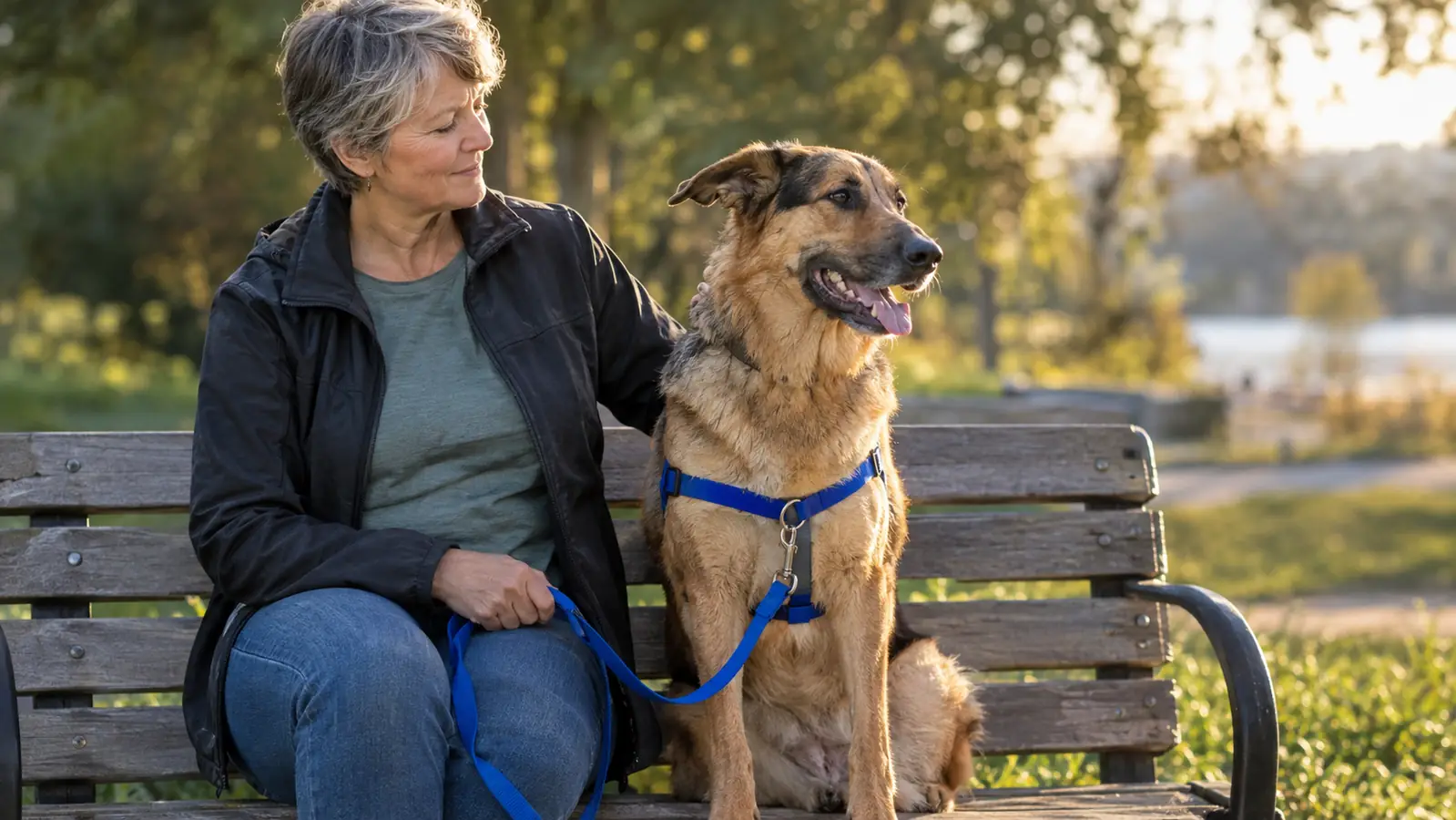
The biggest mistake I made with Ridley was expecting him to behave on a busy sidewalk before he understood the rules in a quiet one. Dogs do not generalize well. A dog that walks beautifully in your kitchen may fall apart the moment he sees a squirrel, because in his mind those are two completely different situations. You have to teach the skill in easy places first, then gradually add distractions.
Our progression went like this: first, laps around the backyard. Then, the sidewalk in front of our house at six in the morning, when the street was empty. Then, the quiet loop around the block. Then, the park at off-hours. Only after Ridley could hold a loose leash in all of those places did we attempt the busy downtown sidewalk, and even then I kept the first few trips short. Each new level of distraction is a new lesson, and you have to be willing to go back a step when your dog is overwhelmed.
This is also where the front clip earns its keep. When Ridley spotted a squirrel and lunged, the PetSafe Easy Walk turned him back toward me before he could build up speed. That gave me a second to get his attention with a treat and a cheerful word. Without the harness, I would have been bracing against a 55-pound dog mid-lunge, which is not a training moment. It is just a fight.
Step 5: Be patient through the plateau, because there will be one
Around week three, Ridley seemed to forget everything he had learned. He pulled at the mailbox, lunged at a jogger, and generally acted like the dog I had adopted, not the dog I had been training. I almost gave up. I remember standing on the sidewalk thinking that maybe he was just too much dog for me, and that I had made a mistake adopting a reactive rescue.
What I learned, from talking to a friend who had trained her own difficult dog, is that this plateau is normal. Dogs, like people, do not improve in a straight line. They improve in fits and starts, and the plateaus are often the brain consolidating what it has learned. The answer is not to change the plan. It is to keep the plan boring and consistent, and to lower your expectations for a few days. I went back to the quiet morning loop, kept the sessions short, and celebrated the small wins. Within a week, Ridley was walking better than he had before the plateau.
If you are in the middle of your own plateau right now, here is what I would tell you: keep going. The dog that pulls on a leash today is not the dog you will have in six weeks. The harness is not magic, and neither am I. What worked for us was a good tool, a simple plan, and the willingness to do the same boring thing every single day until it stuck.
What Else Helps
The PetSafe Easy Walk was the foundation of our training, but a few other things made the process faster and more pleasant. A treat pouch that clips to your belt means you are not fumbling in your pockets while your dog waits. A six-foot leash, not a retractable one, gives you consistent feedback and keeps the dog close enough to learn. And a regular walking schedule helps more than you would think. Dogs are creatures of habit, and Ridley settled into training much faster once our two daily walks happened at roughly the same times.
I also want to say something about management. Training is not the only tool. If your dog cannot handle the sight of other dogs yet, cross the street early instead of forcing a close pass. If the mail carrier comes at the same time every day, walk the other direction. Managing the environment is not cheating. It is how you set your dog up to succeed, and every success builds the new habit.
The day I stopped fighting the pull and started redirecting it was the day the walks finally got better.
What I'd Tell You If We Were Sitting at My Kitchen Table
If you came over to my house in Sun Prairie and asked me how to stop your dog from pulling, this is what I would say. Get a front-clip harness like the PetSafe Easy Walk, fit it properly, and commit to the boring work. Stop when the leash tightens. Reward the loose leash. Practice in easy places first. And do not quit during the plateau, because the plateau is where most people quit, and it is also where the real progress starts.
You do not need to be a professional trainer to do this. I am a retired school bus driver, not a dog expert. I just had a dog who pulled hard enough to hurt my shoulder, and I found a plan that worked. If Ridley can learn to walk on a loose leash, your dog can too. Give it six weeks, keep your sessions short, and be the boring, consistent person your dog needs you to be.
Give your walks a fresh start with the PetSafe Easy Walk
The front clip gently turns pulling into turning, so you can focus on teaching instead of bracing. It worked for a 55-pound rescue with a serious pulling habit. It can work for your dog too.
Amazon Check Today's Price on Amazon →