
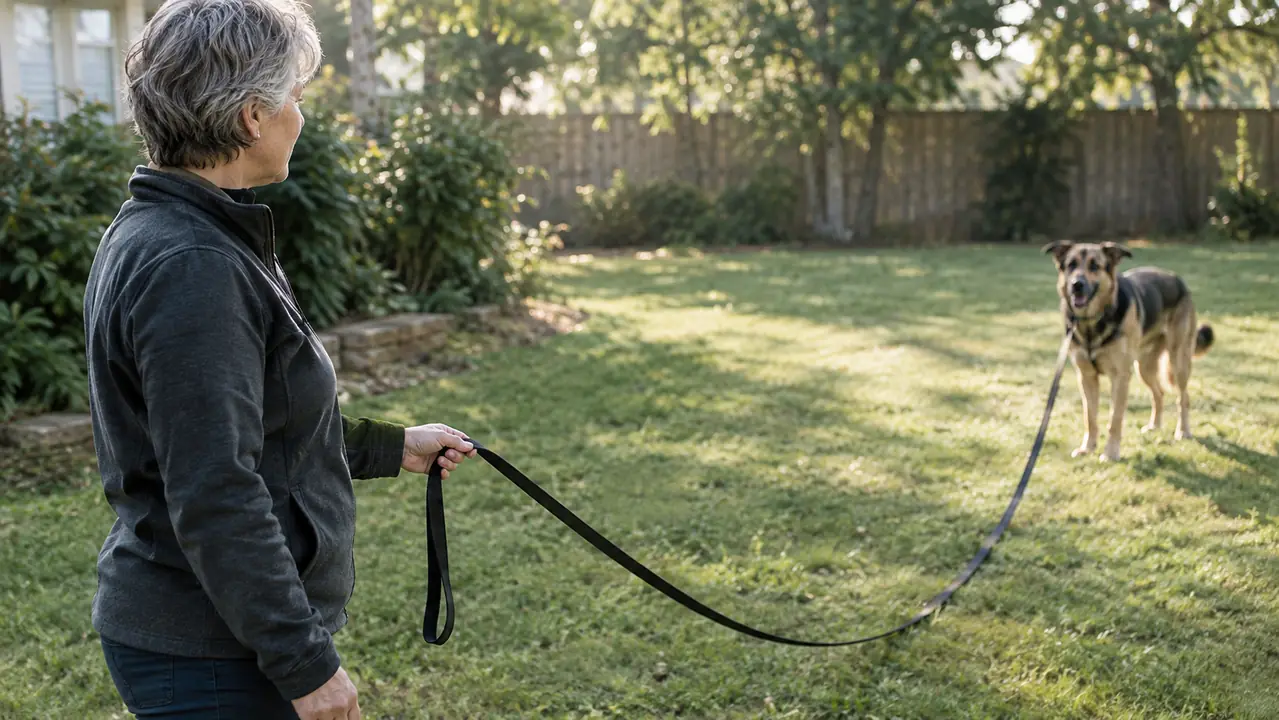
I bought the Hi Kiss 20-foot training leash because I was tired of the same loop every single walk. Ridley would see another dog, lock on, and hit the end of his six-foot leash like it was a wall. Then I would brace, he would cough, and we would both go home frustrated. Two years into training a reactive shepherd mix, I knew the answer was supposed to be a long line. What nobody told me is that a long line comes with its own set of problems, and the Hi Kiss leash has a few of them in particular.
This is the honest version. I have used the Hi Kiss 20-foot leash for about a year, on neighborhood walks, in the backyard, and at a quiet park. It is a good tool, and I still reach for it most mornings. But it tangles, it is heavier than you expect, and the clip is not what I would call rugged. Here is what I wish someone had explained before I ordered it.
The Quick Verdict
A solid, affordable long line for everyday recall practice, as long as you know it will tangle and you are gentle with the clip.
Amazon Check Today's Price →A 20-foot line for a dog that needs room to think
The Hi Kiss training leash gives Ridley enough space to sniff, circle, and come back on his own terms. That is the whole point of long-line work.
Amazon Check Today's Price on Amazon →How I've Used It
Ridley is a 4-year-old shepherd mix, about 55 pounds, and he came to us from a shelter at roughly 18 months with a long list of habits we needed to undo. He pulled, he lunged, he panicked. The first year was mostly management. The second year was mostly training. The Hi Kiss leash came in during that second year, when I finally accepted that a six-foot leash was not enough for the kind of work we needed to do.
My routine is simple. Two neighborhood walks a day, plus short training sessions in the kitchen and the backyard. With the Hi Kiss leash, I use the backyard for recall practice in the morning, then switch to the neighborhood for a walk where Ridley gets to move at his own pace. The 20-foot length means he can sniff a patch of grass, check a fence line, and still be close enough that I can step on the line if a dog appears around the corner.
The leash comes out three or four times a week for dedicated recall practice, usually in the late afternoon when the backyard is quiet. I start each session with a few easy recalls at short distance, let out more line as he gets it right, and end before he gets bored. Most sessions are ten to fifteen minutes. That is enough to make progress without turning recall into a chore for either of us.
I also used it at a quiet park on weekends, clipped to his harness rather than his collar. That is the setup I recommend. A long line on a flat collar is a recipe for a sore neck if the dog hits the end at speed. On a harness, the Hi Kiss leash becomes a teaching tool instead of a restraint.
What Nobody Tells You About the Tangles
Here is the thing I did not expect. A 20-foot leash tangles constantly. Not sometimes. Constantly. Ridley circles, the line wraps around his back legs, and suddenly we are doing a little dance while I untwist him. The Hi Kiss leash is a flat nylon line, which means it twists more easily than a round rope line. I learned to keep the handle end under my foot while he moved, and that helped, but it did not fix the problem entirely.
The tangle issue is not a defect. It is physics. Any long line will wrap around a dog that likes to circle, and Ridley circles a lot. But the flat webbing of the Hi Kiss leash makes the tangles tighter and harder to undo than the round lines I tried later. If your dog is a straight-line runner, you will barely notice. If your dog is a sniffer and a circler, budget a few minutes of untangling into every session.
What helped most was changing how I held it. I stopped trying to keep the whole line off the ground. In the backyard I let most of it drag behind Ridley and only held the last few feet. A dragging line tangles less than a line held halfway in the air, because it lies flat instead of swinging. When I needed more control, I gathered loops into my hand, never around it.
The worst one happened on a Tuesday morning in late September. Ridley found a scent along the fence line, circled twice, and came back with the line wrapped around his back legs and under his belly in a figure eight. He stood there looking at me like I had done it on purpose. I had to set down the treat pouch, kneel on the damp grass, and work the webbing loose one loop at a time. It took close to four minutes, and by the end the line had a few new creases where it had been twisted tight. That was the morning I started paying attention to which direction he was circling, and I began stepping the opposite way to keep the line from stacking up.
The tangles are not a defect. They are physics. Any 20-foot line will wrap around a dog that likes to circle, and Ridley circles a lot.
The Weight and the Clip
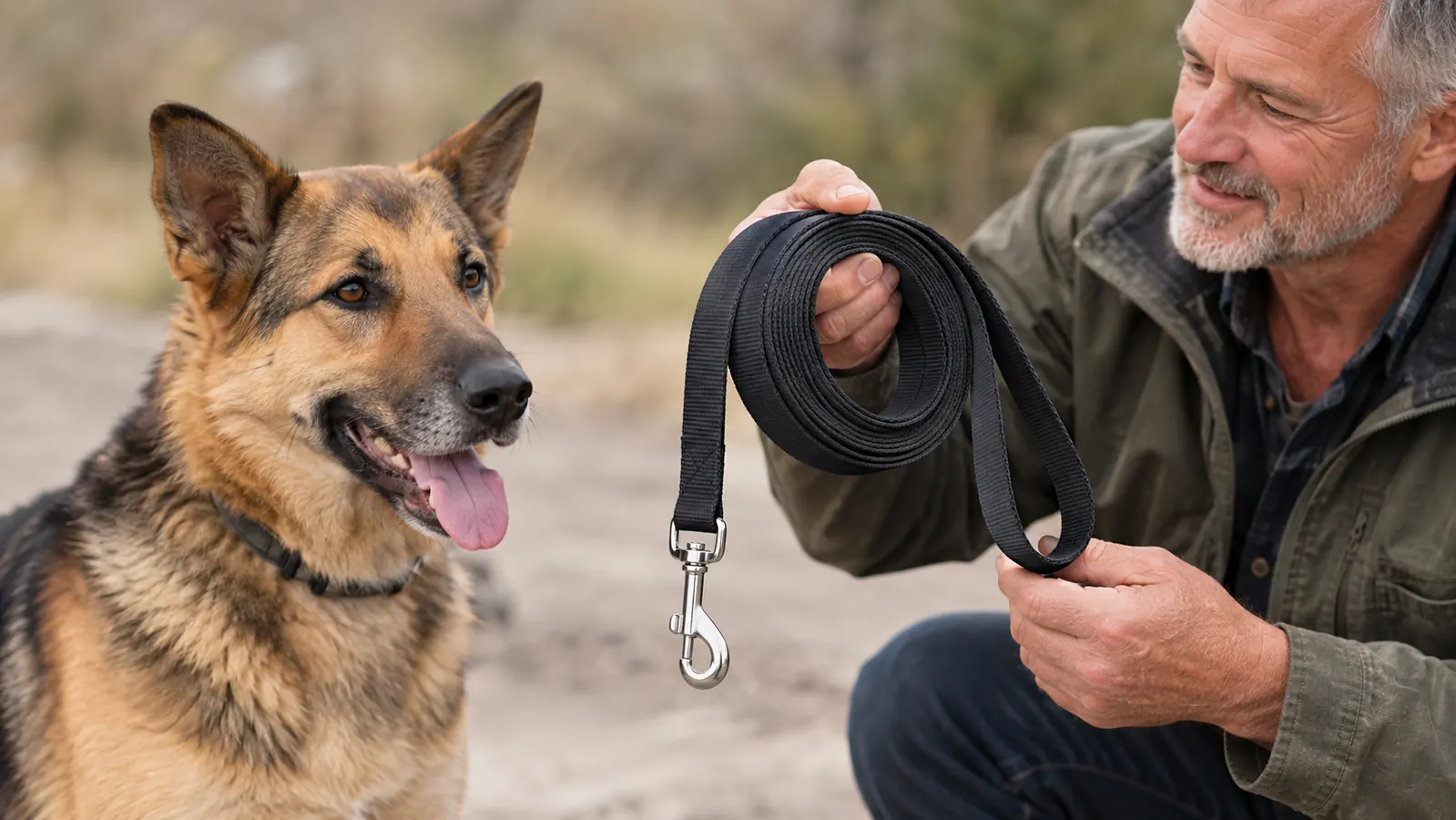
The second thing nobody tells you is that a 20-foot leash is heavier than it looks. The Hi Kiss leash is not a lightweight line. The webbing is thick, the stitching is solid, and the clip is a metal bolt snap. All of that adds up. In the hand, it feels like a real piece of equipment, which is good for durability and less good for long training sessions. My hand got tired holding the coiled line during a 30-minute park session. I started clipping the handle to my belt loop instead, and that worked much better.
By the end of a fifteen-minute session my forearm noticed it, especially when the line was wet. If you have arthritis in your hands or wrists, that is worth thinking about. A shorter length, such as 15 feet, is lighter and easier to manage, and for small-yard recall work it is plenty.
The clip is my biggest honest complaint. The metal bolt snap on the Hi Kiss leash is functional, but it is not what I would call heavy duty. It opens smoothly and closes securely, and it has not failed in a year of regular use. But compared to the thicker clips on some of the other long lines I have handled, it feels like the part most likely to wear out first. I check it before every walk now, the same way I check Ridley's harness straps.
For a 55-pound dog, the clip is adequate. For a dog much larger, or a dog that hits the end of the line hard and often, I would want something with a thicker gauge. That is not a reason to avoid the Hi Kiss leash. It is a reason to know what you are buying.
Before every session I give the clip a quick look and a tug. I check that the spring snaps closed fully and that there is no grit in it. After muddy days I rinse the clip separately and work it open and closed a few times so the spring stays smooth. It takes ten seconds and it is the kind of habit that keeps a small complaint from ever becoming a real problem.
What It Does Well
With the complaints out of the way, here is what the Hi Kiss leash does well. The 20-foot length is genuinely useful. Ridley gets to move, explore, and make choices, and I get to practice recall without the pressure of a short leash. When he does come back, I mark it and give him a treat. The long line makes that whole loop possible.
The length is the real gift. Twenty feet is long enough that Ridley feels free to sniff and explore, and short enough that I can still gather him in quickly. In the yard it means I can practice a recall from the far fence, which is something I could never do on a six-foot leash without letting him off entirely.
The webbing is easy to clean. We have had mud, rain, and the occasional puddle incident, and the Hi Kiss leash rinses off and dries quickly. The stitching has held up through daily use, and the handle is comfortable enough to hold for a neighborhood walk. For the price, the build quality is better than I expected.
It also does not soak up much water. After a session in wet grass, the line is damp, not heavy and dripping, and it dries overnight hung over the shower rod. The color has faded a little in the sun, which I expected, but the webbing itself still feels as strong as the day it arrived.
I also appreciate that the Hi Kiss leash is a single flat line with no knots and no loops in the middle. Some long lines have handles or rings every few feet, which sounds useful and turns out to be a snag hazard. This one is simple. That simplicity is a feature.

Pros and Cons
What I Liked
- Genuinely useful 20-foot length for recall practice in a backyard or quiet park
- Flat webbing rinses clean and dries fast after mud and rain
- Stitching and handle have held up through two months of daily use
- Simple design with no knots or loops in the middle to snag on brush
- Priced like an entry-level tool, which is exactly where most owners start
Where It Falls Short
- Flat webbing twists and tangles more than a round rope line, especially with a circling dog
- Heavier than it looks, and my hand tired holding the coiled line during long sessions
- The metal bolt snap is functional but not heavy duty, and I check it before every walk
Who This Is For
The Hi Kiss training leash is for owners who are actively working on recall, and who understand that a long line is a training tool, not a hands-free solution. It is for people like me, who have a dog that needs space to make good choices, and who are willing to stand still, wait, and reward the return. If you are doing short daily sessions in a backyard or a quiet park, this leash will serve you well.
It is a good match for a medium dog in a fenced yard or a quiet park, an owner who can commit to short regular sessions, and anyone who wants to practice recall safely before ever thinking about off-leash time.
It is also for owners who want to try long-line work without spending a lot. The Hi Kiss leash is priced like an entry-level tool, and it performs like one. That is not an insult. Entry-level is exactly where most of us start.
Who Should Skip It
Skip the Hi Kiss leash if your dog is a serious puller who hits the end of the line at full speed. The clip is the weak point, and a hard-pulling dog will test it in ways a reactive sniffer never will. Skip it if you want a tangle-free experience, because no flat webbing line will give you that. And skip it if you need a line longer than 20 feet for a large open space, because the longer versions of this leash get heavier and harder to manage.
If your dog is over 70 pounds, or if you are training in wide open fields where a 30 or 50-foot line would serve better, I would look at a round rope line with a heavier clip. The Hi Kiss leash is a good tool for the right job. The right job is everyday recall practice with a medium-sized dog in a contained space.
Alternatives I Considered
I tested a round rope long line after the tangle issue got to me, and it did tangle less. The tradeoff was that the rope line was harder to clean and felt rougher in my hand. I also looked at a biothane line, which is waterproof and easy to wipe down, but it is noticeably more expensive and stiffer when new. For my daily routine, the Hi Kiss leash is the better balance of cost, comfort, and function.
I also looked at biothane lines, which are waterproof and wipe clean, and they are a nice upgrade if you train in wet grass every day. For most people starting out, though, flat webbing like the Hi Kiss is perfectly good, and it is a fine way to find out how much long-line work you will actually do before spending more.
The honest summary is this. The Hi Kiss training leash is not the last long line you will ever buy. It is the first one, the one that teaches you what you actually need. It taught me that I want a round line for open fields and a flat line for the backyard. It taught me to check clips before every walk. And it taught me that the tool matters less than the patience, because Ridley's recall improved the most on the days I was willing to stand still and wait.
Start with the 20-foot version and learn what your dog needs
The Hi Kiss training leash is an affordable way to start long-line work today. You can always upgrade later once you know what your dog actually needs.
Amazon Check Today's Price on Amazon →